We use cookles to Improve your online experience. By continuing browsing this website, we assume you agree our use of cookies.

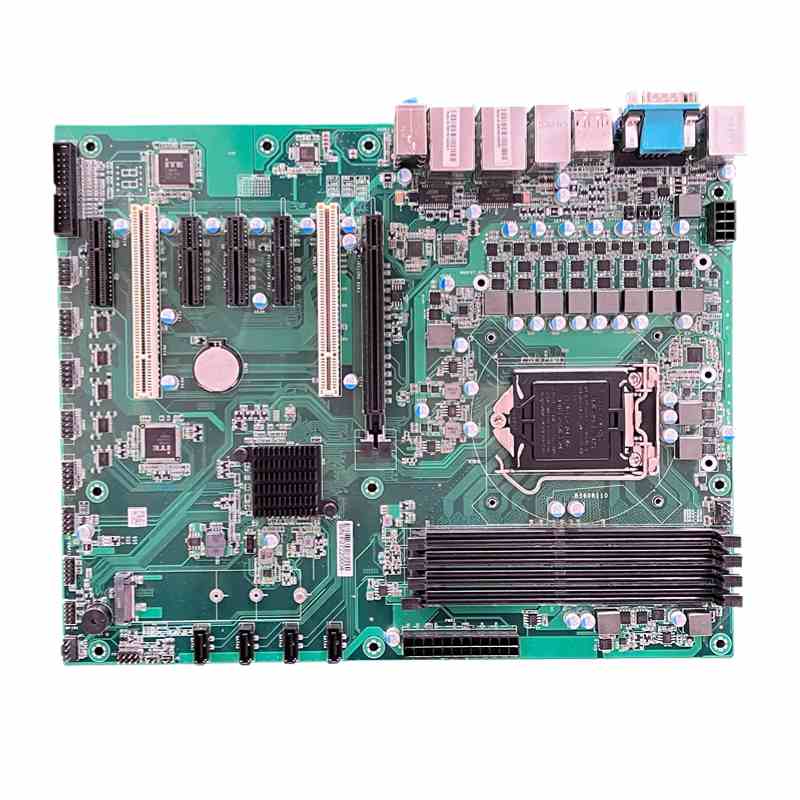
B560 ATX Industrial Motherboard: Unleashing Power with 5 PCIe Slots and 4U Rack Support
September 8th, 2025
174 views
B560 ATX Industrial Motherboard: Unleashing Power with 5 PCIe Slots and 4U Rack Support
In the dynamic realm of industrial computing, the motherboard serves as the nerve center, connecting and coordinating various components to ensure seamless operation. The B560 ATX industrial motherboard, with its remarkable features such as 5 PCIe slots and 4U rack support, has emerged as a game - changer, catering to the demanding requirements of industrial applications—from high - volume manufacturing to precision quality control.
1. The Significance of the B560 Chipset
The B560 chipset, developed by Intel, forms the foundation of this powerful motherboard. It is engineered to support both 11th Gen Intel Core processors and is backward - compatible with select 10th Gen models. This versatility allows businesses to upgrade or build systems with a wide range of CPU options, optimizing performance based on their specific needs—whether it’s a Core i3 for basic sensor monitoring or a Core i7 for complex AI - driven defect detection.
1.1 PCIe 4.0 Support: A Leap in Data Transfer
One of the most notable features of the B560 chipset is its support for PCIe 4.0. With up to 20 PCIe 4.0 lanes (split between the CPU and chipset), it offers significantly faster data transfer speeds compared to its predecessors (e.g., B460’s PCIe 3.0). In industrial applications, where real - time data processing is crucial, this can make a world of difference. For example, in high - resolution image processing tasks, such as those found in industrial vision inspection systems, a 4K industrial camera capturing 30 frames per second (FPS) generates approximately 120MB of data per second. PCIe 4.0, with its 8GB/s per lane bandwidth, ensures that this data can be transferred to the GPU for processing without bottlenecks. This eliminates latency, enabling quicker and more accurate quality control decisions—critical for high - speed production lines where even a 100ms delay could lead to defective products passing inspection.
1.2 Intel Optane Memory Compatibility
The B560 chipset also supports Intel Optane Memory, which is a boon for industrial systems that deal with large datasets. Industrial applications often require storing and retrieving vast amounts of historical data, such as in trend analysis for equipment performance monitoring or compliance - mandated inspection logs. Intel Optane Memory acts as a high - speed cache, accelerating access to frequently used files (e.g., reference images for defect detection, algorithm libraries). This reduces the time needed to retrieve critical data from slower storage (e.g., SATA HDDs), maintaining consistent operation speeds during long 24/7 production shifts. For instance, a manufacturing plant using Optane Memory with a B560 motherboard reported a 40% reduction in time to load 10GB inspection software libraries, cutting idle time for vision systems.
2. The Advantage of 5 PCIe Slots
2.1 Component Expansion for Diverse Industrial Needs
The presence of 5 PCIe slots on the B560 ATX industrial motherboard provides unparalleled flexibility for component expansion—addressing the diverse needs of industrial systems that often require multiple specialized peripherals.
2.1.1 Multi - GPU Configuration for Parallel Processing
In applications such as 3D rendering for product design or advanced machine learning - based quality control, parallel processing power is essential. The motherboard’s 2 PCIe 4.0 x16 slots (a key feature of many industrial B560 models) allow for the installation of multiple GPUs. For instance, with two NVIDIA RTX A2000 GPUs (each leveraging PCIe 4.0 x16 bandwidth), the B560 motherboard can cut image analysis time for 3D automotive part scans from 2 seconds to 0.8 seconds. This is a huge advantage for high - volume production lines (e.g., 1,000 parts per hour) where faster inspection directly translates to higher throughput.
2.1.2 Dedicated Capture Cards and Network Expansion
Industrial cameras often use specialized interfaces like GigE Vision or Camera Link—requiring dedicated frame grabber cards. The B560’s PCIe 3.0 x4 slot can host a frame grabber (e.g., Basler dart) to connect 4–8 GigE cameras, enabling multi - angle vision inspection (e.g., inspecting all sides of a PCB simultaneously). Additionally, a PCIe x1 slot can accommodate a 10G Ethernet card (e.g., Intel X550 - T2), facilitating seamless remote data transmission to a central MES (Manufacturing Execution System) database. This expansion flexibility is crucial for customizing systems—for example, a logistics warehouse could add a PCIe - based RFID reader card to track inventory alongside camera - based package dimensioning.
3. 4U Rack Support: Ideal for Industrial Environments
3.1 Space - Efficient and Robust Deployment
The 4U rack support of the B560 ATX industrial motherboard aligns with the standard infrastructure of industrial control rooms and data centers, making it a practical choice for space - constrained environments.
3.1.1 Standardized Rack Mounting
The 4U form factor (177.8mm height) adheres to EIA - 310 industrial rack standards, ensuring compatibility with existing 19 - inch racks. This standardization simplifies installation: technicians can easily slide the B560 - based system into existing racks alongside servers, UPS units, and network switches. For example, a semiconductor plant with a crowded control room can integrate 3 B560 - based vision systems into a single 4U rack—saving 60% of the space required for standalone systems.
3.1.2 Enhanced Durability and Cooling
Industrial environments are rife with challenges: dust, vibration, and temperature fluctuations. 4U rack - optimized B560 motherboards (e.g., Advantech AIMB - 587) address these with industrial - grade design:
- Dust Resistance: Conformal coatings on the PCB prevent dust and moisture from shorting components—critical for food processing plants or metalworking facilities where airborne particles are prevalent.
- Vibration Tolerance: Components are soldered with reinforced joints, and the motherboard meets IEC 60068 - 2 - 6 standards (10–2000Hz, 10G acceleration), ensuring stability in environments like assembly lines with vibrating machinery.
- Cooling Efficiency: 4U racks allow for integrated cooling solutions—such as front - to - back airflow fans and passive heat sinks on the VRM (Voltage Regulator Module). This keeps component temperatures below 85°C even in factory environments with ambient temperatures up to 45°C, preventing thermal throttling of the CPU or GPU.
4. Memory and Storage Capabilities
4.1 DDR4 Memory: High - Speed and High - Capacity
The B560 ATX industrial motherboard supports DDR4 memory with speeds up to 5333MHz (when overclocked) and a maximum capacity of 128GB (4 × 32GB DIMMs). This is critical for industrial tasks that demand real - time data buffering and complex computations.
4.1.1 Real - Time Data Processing
For multi - camera vision systems, memory acts as a temporary buffer to prevent data loss. A 4 - camera setup capturing 4K/30FPS generates ~480MB/s of data; 64GB of DDR4 - 3200 memory can store 2 minutes of raw data, ensuring the GPU never runs out of data to process—even during peak production. In a pharmaceutical packaging line, this prevents missed inspections of pill bottles due to data gaps.
4.1.2 Running Complex Industrial Applications
Industrial algorithms (e.g., predictive maintenance models, 3D point cloud analysis) require large memory footprints. With 128GB of DDR4, the B560 motherboard can run multiple models simultaneously: for example, one model detecting surface defects in automotive parts and another optimizing conveyor belt speed based on defect rates. This eliminates the need to switch between applications, improving operational efficiency.
4.2 Storage Interfaces: Meeting Diverse Industrial Storage Needs
The motherboard’s 2–3 M.2 slots (PCIe 4.0 x4) and 6–8 SATA III ports cater to both speed - critical and capacity - critical storage needs.
4.2.1 High - Speed M.2 NVMe SSDs
M.2 NVMe SSDs (e.g., Samsung 990 Pro) deliver read speeds up to 7,450MB/s—ideal for storing frequently accessed data like inspection software and real - time camera feeds. In a PCB inspection system, loading a 10GB library of defect reference images takes <2 seconds with an NVMe SSD, compared to 10 seconds with a SATA SSD. This cuts idle time for the vision system, enabling it to inspect 50% more PCBs per hour.
4.2.2 SATA HDDs/SSDs for Archiving
SATA III ports support large - capacity HDDs (e.g., 16TB Seagate IronWolf) for long - term data archiving. Industries like aerospace and medical device manufacturing require 5–10 years of inspection data retention for compliance (e.g., FDA regulations). A 16TB SATA HDD can store 2 years of daily inspection logs (assuming 20GB of data per day), providing a cost - effective solution for compliance without compromising speed for active data.
5. Real - World Applications
5.1 Electronics Manufacturing
In PCB production, precision is non - negotiable. B560 ATX motherboards power systems that connect 4–6 high - resolution cameras (e.g., Omron FH - Series) via frame grabber cards, inspecting PCBs at 1,200 DPI. Two GPUs run parallel algorithms: one analyzing solder joints for bridges or cold joints, the other verifying component placement. A leading electronics manufacturer reported a 30% reduction in defect escape rates after upgrading to B560 - based systems—thanks to faster data processing that eliminated latency - caused missed defects.
5.2 Automotive Industry
For 3D part and paint inspection, B560 motherboards handle 3D laser scanners (e.g., Keyence IM - 700) that stream 1GB point cloud data per scan via PCIe 4.0 to a GPU for mesh generation. Multi - camera setups inspect car body paint for scratches or color mismatch, processing results in <1 second per panel. A car assembly plant saw a 20% increase in production throughput—inspection time per vehicle dropped from 5 minutes to 3 minutes, aligning with the plant’s 60 - second-per - vehicle production goal.
5.3 Food and Beverage Industry
In packaging lines, B560 motherboards support high - speed line scan cameras (e.g., Basler L104k - G) capturing 10,000 lines per second to inspect packaging seams on a 600m/min line. Edge AI models on the CPU detect label misalignment (>2mm skew) in real - time, triggering line stops. A beverage company reduced packaging waste by 15%—the B560’s fast processing prevented mislabeled cans from reaching consumers, avoiding $50,000+ in recall costs annually.
6. Comparison with Other Motherboards
|
Motherboard Type
|
Key Advantages
|
Key Limitations
|
Best For
|
|
B560 ATX
|
5 PCIe slots, PCIe 4.0, 128GB DDR4, 4U rack support, industrial durability
|
No PCIe 5.0, limited overclocking
|
Mid - to high - volume industrial applications (e.g., PCB inspection, automotive 3D scanning)
|
|
B460 ATX
|
Lower cost, stable for 10th Gen CPUs
|
No PCIe 4.0, max 64GB DDR4
|
Entry - level tasks (e.g., basic sensor monitoring)
|
|
Z590 ATX
|
PCIe 4.0, full overclocking
|
Higher cost (~30% more than B560), no industrial durability
|
High - end labs (e.g., research - intensive AI testing)
|
|
Micro - ATX (B560)
|
Compact size, lower power
|
Only 2–3 PCIe slots, max 64GB DDR4
|
Space - constrained small factories (e.g., boutique electronics)
|
The B560 ATX stands out for balancing performance, expandability, and cost—avoiding the overkill of Z590’s high price and the limitations of B460’s slow data transfer.
7. FAQ
7.1 Can the B560 ATX industrial motherboard support 8K industrial cameras?
Yes, but with caveats. An 8K camera generates ~480MB/s of data—well within the B560’s PCIe 4.0 x16 slot bandwidth (16GB/s). However, multiple 8K cameras require careful lane allocation: a second 8K camera would need a PCIe 3.0 x4 slot (4GB/s), which may cause bottlenecks during peak data transfer. For multi - 8K setups, consider a B660 ATX (with more PCIe 4.0 lanes) or limit to 1–2 8K cameras with the B560.
7.2 Is the B560 ATX compatible with Linux - based industrial software?
Absolutely. Major manufacturers (ASUS, MSI, Advantech) provide Linux drivers for B560 chipsets, network cards, and storage. Linux - based tools like OpenCV (for vision processing) and Node - RED (for automation) run seamlessly—even complex tasks like 3D point cloud analysis via PCL (Point Cloud Library) work with the B560’s 128GB memory. A robotics firm reported no compatibility issues running Ubuntu 22.04 LTS on B560 - based systems for warehouse automation.
7.3 How does the B560 handle power outages in industrial settings?
Industrial - grade B560 motherboards support UPS integration via standard ATX power connectors. When paired with a 4U rack UPS (e.g., APC Smart - UPS), the system can gracefully shut down or switch to backup power during outages. Some models also include non - volatile RAM (NVRAM) to save inspection data mid - process, preventing data loss. A food plant using this setup avoided losing 8 hours of batch inspection data during a 2 - hour power outage.
7.4 Can the B560 support multi - camera synchronization for 3D vision?
Yes—via hardware or software. Hardware sync uses a PCIe - based sync card (e.g., National Instruments PCIe - 6612) in one of the B560’s PCIe slots, aligning camera triggers within 1μs—critical for 3D scanning (e.g., measuring car door gaps from 4 angles). Software sync (via GenICam) works for 2D tasks (e.g., label inspection), using the CPU to coordinate timestamps with <10ms variance.
8. Industrial - Grade Customization Services
To meet unique industrial needs, manufacturers offer customization for B560 ATX motherboards:
- Component Locking: Fixed BOM (Bill of Materials) for 5+ years of supply stability—critical for industries with long product lifecycles (e.g., aerospace).
- Interface Modification: Adding specialized ports (e.g., RS485 for legacy sensors, PoE for IP cameras) to reduce adapter use.
- Firmware Tuning: Custom BIOS settings to optimize boot time (e.g., 10 - second boot for emergency shutdown systems) or disable unused features to reduce power consumption.
A defense contractor customized B560 motherboards with military - grade connectors and extended temperature support (- 55°C to +95°C) for field - deployed vision systems.
9. Conclusion
The B560 ATX industrial motherboard, with its 5 PCIe slots, 4U rack support, and robust performance, is a versatile workhorse for industrial computing. It addresses the core needs of modern industrial applications—fast data transfer via PCIe 4.0, space - efficient deployment, and durability in harsh environments—while remaining cost - effective. Whether powering PCB inspection lines, automotive 3D scanners, or food packaging verification systems, the B560 delivers the reliability and flexibility industrial users demand.
For businesses looking to upgrade or deploy new industrial systems, the B560 ATX motherboard offers a future - proof solution: its support for 10th/11th Gen Intel CPUs, 128GB DDR4, and PCIe 4.0 ensures compatibility with upcoming peripherals. To explore custom configurations or get technical support for your specific application, contact industrial motherboard manufacturers like Advantech, DFI, or ShwayPCB at yuan@shwaypcb.com—their teams can design a B560 - based solution tailored to your workflow.

Copyright © 2005-2025 ShwayPCB : PCB Fabrication and Assembly Manufacturer. All Rights Reserved. POWERED BY UEESHOP


Copyright © 2005-2025 ShwayPCB : PCB Fabrication and Assembly Manufacturer. All Rights Reserved. POWERED BY UEESHOP