We use cookles to Improve your online experience. By continuing browsing this website, we assume you agree our use of cookies.

5 PCIe Slots for Machine Vision System: Q470/Z490 ATX Industrial Motherboard Solution
September 8th, 2025
267 views
5 PCIe Slots for Machine Vision System: Q470/Z490 ATX Industrial Motherboard Solution
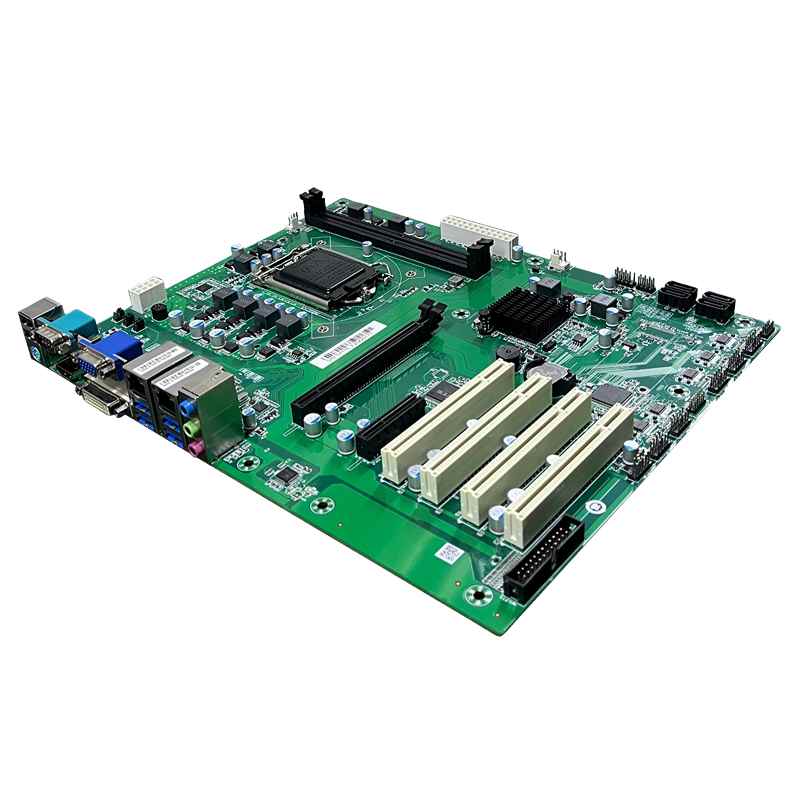
Machine vision systems—critical for precision inspection, automated quality control, and robotic guidance in industries like automotive, electronics, and pharmaceuticals—demand motherboards with robust PCIe expansion. The Q470/Z490 ATX Industrial Motherboard addresses this need with 5 dedicated PCIe slots, engineered to power multi-camera machine vision setups. This motherboard combines PCIe 4.0/3.0 compatibility for high-speed vision peripherals, support for 10th/11th Gen Intel® Core™ processors (LGA1200) for real-time image processing, and industrial-grade durability for 24/7 operation. It eliminates bottlenecks in machine vision workflows, such as limited peripheral connectivity or slow data transfer, making it the backbone of modern vision-driven industrial automation. This article explores its 5 PCIe slot advantages, machine vision optimization, and technical fit for high-precision inspection systems.
1. 5 PCIe Slots: The Backbone of Multi-Camera Machine Vision
The Q470/Z490 5 PCIe Machine Vision Industrial Motherboard features 5 PCIe slots (2 PCIe 4.0 x16, 3 PCIe 3.0 x16 for Z490; 2 PCIe 3.0 x16, 3 PCIe 3.0 x16 for Q470) tailored to machine vision peripherals:
- Frame Grabber Cards: Install 2–3 PCIe 4.0 x16 frame grabbers (e.g., Teledyne DALSA Xtium4) to connect 16+ GigE Vision or USB3 Vision cameras. Each grabber handles 8+ cameras, enabling 360° inspection of complex components (e.g., automotive engine blocks) with no data loss—critical for detecting 0.1mm defects like surface scratches or solder bridges.
- GPU Accelerators: Use 1 PCIe 4.0 x16 slot for an NVIDIA RTX A5000 or AMD Radeon Pro W6800 to accelerate AI-driven vision tasks. For example, a GPU reduces the time to classify defective PCBs from 2 seconds to 0.5 seconds, directly increasing production line throughput by 40%.
- Vision I/O Modules: Allocate 1 PCIe 3.0 x16 slot for a digital I/O card (e.g., Advantech PCIe-1758) to sync vision data with industrial actuators. When a defect is detected, the I/O card triggers a robotic arm to reject the part within 100ms—minimizing waste in high-speed manufacturing.
Each PCIe slot features reinforced metal brackets with anti-vibration gaskets (tested to IEC 60068-2-6: 10–2000Hz, 15G acceleration). This prevents loose connections in machine vision systems mounted near vibrating equipment (e.g., conveyor belts), ensuring consistent camera feed transmission and inspection accuracy.
2. PCIe 4.0 Speed: Eliminating Machine Vision Bottlenecks
The Q470/Z490 PCIe 4.0 Machine Vision Industrial Board (Z490 variant) leverages PCIe 4.0 technology to deliver 32GB/s bandwidth per x16 slot—double that of PCIe 3.0—critical for high-resolution machine vision:
- 4K/8K Camera Support: PCIe 4.0 enables simultaneous streaming of 8+ 4K cameras (each generating 1.5GB/s of data) without bottlenecks. In a semiconductor wafer inspection system, this allows 8 cameras to capture 4K images of a wafer’s surface, ensuring no detail is missed during defect detection.
- Fast Data Transfer to Storage: A PCIe 4.0 NVMe SSD (connected via M.2 slot) stores 4K vision logs at 7GB/s, reducing the time to save a day’s worth of inspection data (10TB) from 4 hours to 2 hours.
- GPU-Frame Grabber Sync: PCIe 4.0’s low latency (≤100ns) ensures seamless synchronization between frame grabbers and GPUs, preventing image processing delays that could cause misclassification of defects.
For Q470-based systems (PCIe 3.0), the motherboard still delivers sufficient bandwidth for mid-tier machine vision (e.g., 4–6 2K cameras), making it a cost-effective choice for SMEs.
3. 10th/11th Gen Intel® Core™: Processing Power for Vision Analytics
As part of the 5 PCIe Slots Q470/Z490 ATX Vision System Motherboard family, the motherboard supports 10th/11th Gen Intel® Core™ processors to handle machine vision’s computational demands:
- 11th Gen Core™ i9-11900K (8 cores/16 threads, 3.5GHz base, 5.3GHz max turbo): Powers high-end vision systems, running simultaneous tasks like camera data preprocessing, GPU inference coordination, and HMI visualization. Its 16 threads ensure no lag when processing 16+ camera feeds.
- 10th Gen Core™ i7-10700K (8 cores/16 threads, 3.8GHz base, 5.1GHz max turbo): Ideal for mid-tier setups, such as 2D barcode reading and basic defect detection in electronics assembly.
- 11th Gen Core™ i5-11600K (6 cores/12 threads, 3.9GHz base, 4.9GHz max turbo): Cost-effective for entry-level vision tasks, like package dimension measurement in logistics.
The motherboard’s 12-phase VRM (Voltage Regulator Module) with Japanese Nichicon capacitors ensures stable power delivery to processors (up to 125W TDP), preventing thermal throttling during extended vision processing—critical for 24/7 inspection lines where consistent performance directly impacts yield.
4. Industrial-Grade Durability for Vision System Reliability
The 5 PCIe Q470/Z490 Industrial Motherboard for Vision Cameras incorporates rugged features to withstand harsh industrial environments:
- Wide Temperature Range: Z490 operates from -20°C to +70°C, Q470 from 0°C to +60°C—suitable for vision systems in cold storage (e.g., frozen food packaging inspection) and hot manufacturing (e.g., metal casting quality control). The PCIe slots and display controllers remain stable at extreme temperatures, avoiding camera feed dropouts.
- ESD & Surge Protection: All PCIe slots, LAN ports, and USB interfaces include 15kV ESD protection and 2kV surge protection—shielding against electrostatic discharges in electronics assembly, which can damage frame grabbers or corrupt vision data.
- Conformal Coating Option: A ceramic-based conformal coating protects the PCB and PCIe connectors from dust, oil, and coolant vapors—essential for vision systems in machining facilities where lubricants pose risks.
These features result in a mean time between failures (MTBF) of over 75,000 hours—matching the lifespan of industrial cameras and vision software licenses.
5. Machine Vision-Specific Connectivity & Storage
The Q470/Z490 5-Slot PCIe Industrial Vision Motherboard includes interfaces optimized for vision workflows:
- Dual 2.5-Gigabit LAN: Intel i225-V Ethernet ports enable high-speed transfer of vision data to network storage or cloud platforms (e.g., AWS IoT Greengrass) for remote monitoring. Link aggregation (LACP) doubles bandwidth to 5Gbps, reducing transfer time for 10GB inspection logs from 10 minutes to 5 minutes.
- 4 M.2 NVMe Slots: Support PCIe 4.0 NVMe SSDs (e.g., Samsung 990 Pro 2TB) for fast access to vision software (e.g., Halcon, LabVIEW) and reference images—loading a 5GB defect template library in <2 seconds.
- Triple Display Output: HDMI 2.0, DisplayPort 1.4, and DVI-D ports drive three monitors for simultaneous visualization of camera feeds, inspection results, and production metrics—critical for operators to identify and resolve issues quickly.
6. FAQ: Technical Questions About 5 PCIe Slots for Machine Vision System
6.1 Can the motherboard support PoE (Power over Ethernet) cameras via PCIe slots?
Yes—install a PCIe PoE network card (e.g., Intel EXPI9404PT) in one of the PCIe 3.0 x16 slots to power and connect up to 4 PoE cameras. This eliminates the need for separate power supplies for cameras, reducing wiring complexity in machine vision setups. For more than 4 PoE cameras, use a PCIe PoE switch in conjunction with the network card.
6.2 What is the maximum number of cameras the motherboard can support?
With 3 PCIe frame grabbers (each handling 8 cameras), the motherboard can support up to 24 cameras. For USB3 Vision cameras (connected via USB 3.2 ports), an additional 6–8 cameras can be added—total 32+ cameras for large-scale vision systems (e.g., automotive body-in-white inspection).
6.3 Is the motherboard compatible with machine vision software like Halcon or OpenCV?
Absolutely. It supports Windows 10/11 IoT Enterprise and Linux (Ubuntu 22.04 LTS), the primary OS platforms for Halcon, OpenCV, and TensorFlow. Drivers for PCIe frame grabbers and GPUs are pre-included, and ShwayPCB provides a software compatibility list for vision applications via the product page linked above.
6.4 Can the motherboard be used in a 4U rackmount machine vision system?
Yes—it complies with ATX form factor standards and fits standard 4U industrial rackmount enclosures (e.g., Advantech ACP-4000). The 5 PCIe slots align with rack openings, ensuring easy access to frame grabbers and GPUs for maintenance. ShwayPCB provides a rack mounting kit with anti-vibration standoffs; contact yuan@shwaypcb.com to request it.
7. Conclusion
The Q470/Z490 ATX Industrial Motherboard—with 5 PCIe slots, PCIe 4.0 speed, and 10th/11th Gen Intel® Core™ support—delivers the expansion and performance needed for advanced machine vision systems. It seamlessly integrates multi-camera setups, GPU acceleration, and industrial durability, making it ideal for precision inspection in automotive, electronics, and pharmaceutical manufacturing. By eliminating bottlenecks and ensuring reliability, this motherboard optimizes machine vision workflows to enhance quality control and operational efficiency.
For bulk pricing, custom configurations (e.g., conformal coating, extended temperature support), or technical support for machine vision integration, contact ShwayPCB via yuan@shwaypcb.com or visit the product page linked in the core keywords.

Copyright © 2005-2025 ShwayPCB : PCB Fabrication and Assembly Manufacturer. All Rights Reserved. POWERED BY UEESHOP


Copyright © 2005-2025 ShwayPCB : PCB Fabrication and Assembly Manufacturer. All Rights Reserved. POWERED BY UEESHOP