We use cookles to Improve your online experience. By continuing browsing this website, we assume you agree our use of cookies.

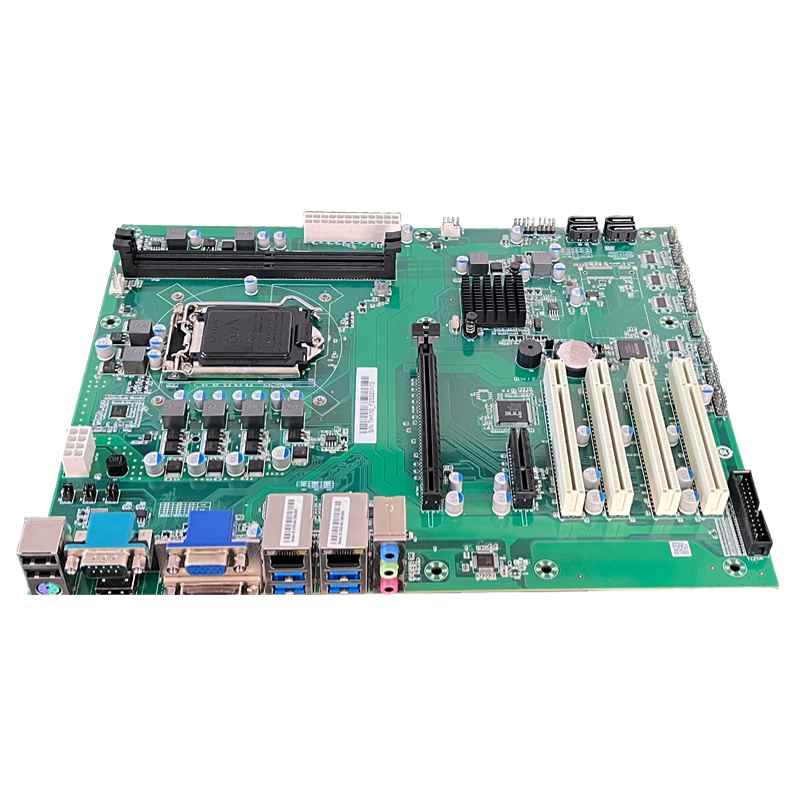
11th Gen LGA1200 Motherboard with Triple Display: Q470/Z490 ATX Industrial Solution for Multi-Monitor Control
September 8th, 2025
179 views
11th Gen LGA1200 Motherboard with Triple Display: Q470/Z490 ATX Industrial Solution for Multi-Monitor Control
In industrial control environments—where operators need to monitor multiple data streams simultaneously (e.g., production metrics, camera feeds, PLC status)—a motherboard with triple display support becomes a critical tool. The 11th Gen LGA1200 Triple Display Industrial Motherboard, a key variant of the Q470/Z490 ATX Industrial Motherboard family, is engineered to meet this demand. It combines native support for 11th Gen Intel® Core™ processors (LGA1200 socket), triple independent display outputs, industrial-grade durability, and PCIe expansion for peripherals—making it ideal for applications like multi-camera vision inspection, centralized HMI (Human-Machine Interface) control, and smart factory monitoring. This article explores its triple display capabilities, 11th Gen processor optimization, and technical fit for industrial multi-monitor workflows.
1. Triple Display Support: Enabling Multi-Stream Industrial Monitoring
The 11th Gen LGA1200 Triple Display Industrial Motherboard leverages Intel® UHD Graphics 750 (integrated into 11th Gen Core™ processors) to deliver three independent display outputs: 1 HDMI 2.0, 1 DisplayPort 1.4, and 1 DVI-D. This configuration supports diverse industrial display needs:
- Resolution & Refresh Rate: Each port supports up to 4K (3840×2160) resolution at 60Hz, enabling crisp visualization of high-detail data (e.g., 4K vision camera feeds for defect detection). For lower-resolution industrial monitors (e.g., 1080p HMIs), the motherboard can drive three displays simultaneously with no performance degradation.
- Multi-Stream Use Cases: In a automotive assembly line control room, operators can use the triple displays to:
- Monitor real-time production metrics (e.g., cycle time, defect rate) on the HDMI-connected HMI.
- View 4K camera feeds of welding stations via the DisplayPort monitor.
- Track PLC status and equipment health on the DVI-D display.
This eliminates the need for display splitters or multiple motherboards, reducing system complexity and failure points.
The motherboard’s display controller also supports display cloning (mirroring the same content across all three screens) for training scenarios or large-area visibility—critical for factories where multiple operators need access to the same critical data (e.g., emergency shutdown procedures).
2. 11th Gen Intel® Core™ (LGA1200) Optimization: Performance for Multi-Task Workflows
As part of the 11th Gen LGA1200 Q470/Z490 Industrial Motherboard family, this motherboard is tailored to unlock the full potential of 11th Gen Intel® Core™ processors (LGA1200 socket), ensuring smooth multi-tasking across triple displays:
- 11th Gen Core™ i9-11900K (8 cores/16 threads, 3.5GHz base, 5.3GHz max turbo): Powers high-demand multi-display setups, such as a centralized smart factory control station running three 4K applications simultaneously (vision inspection software, MES dashboard, and PLC programming tools). The 16 threads prevent lag when switching between displays or processing real-time data.
- 11th Gen Core™ i7-11700K (8 cores/16 threads, 3.6GHz base, 5.0GHz max turbo): Ideal for mid-tier multi-monitor systems, like a logistics sorting center using two displays for barcode scanning data and one for inventory management.
- 11th Gen Core™ i5-11600K (6 cores/12 threads, 3.9GHz base, 4.9GHz max turbo): Cost-effective for entry-level triple-display tasks, such as a small manufacturing line monitoring temperature, pressure, and conveyor speed across three screens.
The motherboard’s 10-phase VRM (Voltage Regulator Module) with Japanese Nichicon capacitors (10,000 hours at 105°C) ensures stable power delivery to 11th Gen processors (up to 125W TDP). This eliminates voltage fluctuations in industrial power grids, preventing display glitches or system freezes—critical for 24/7 multi-monitor control where interruptions can disrupt production.
3. Industrial-Grade Durability for Multi-Display Control Systems
The Q470/Z490 ATX Triple Display Industrial Motherboard incorporates rugged features to withstand harsh industrial environments, ensuring reliable triple-display operation:
- Wide Temperature Range: Operates from -20°C (Z490) to +70°C (Z490) and 0°C (Q470) to +60°C (Q470), suitable for cold storage monitoring (e.g., frozen food packaging lines) and hot manufacturing floors (e.g., metalworking plants). The display controller remains stable even at extreme temperatures, avoiding screen artifacts or signal loss.
- ESD & Surge Protection: All display ports (HDMI, DisplayPort, DVI-D) and external interfaces include 15kV ESD protection and 2kV surge protection—shielding against electrostatic discharges common in electronics assembly, which can damage display controllers or corrupt video signals.
- Conformal Coating Option: A perfluoropolyether-based conformal coating protects the PCB and display connectors from dust, oil, and moisture—essential for multi-display systems in food processing or chemical manufacturing plants where environmental contaminants pose risks.
These features result in a mean time between failures (MTBF) of over 70,000 hours—ensuring the motherboard and its triple-display setup operate reliably for 7+ years in 24/7 industrial environments.
4. PCIe Expansion & Connectivity: Complementing Multi-Display Workflows
The 11th Gen LGA1200 PCIe 4.0 Triple Display Industrial Motherboard includes flexible expansion and connectivity to support multi-display industrial workflows:
- PCIe Slots: 5 PCIe slots (2 PCIe 4.0 x16 for Z490, 2 PCIe 3.0 x16 for Q470, 3 PCIe 3.0 x16) enable integration of peripherals that feed data to triple displays:
- Frame grabber cards (e.g., Teledyne DALSA Xtium2) to connect 8+ vision cameras, providing real-time video feeds to display monitors.
- Industrial I/O cards (e.g., Advantech PCIe-1716) to collect sensor data (temperature, pressure) for visualization on HMI displays.
- Storage Interfaces: 4 M.2 NVMe slots (PCIe 4.0 for Z490) and 6 SATA3 ports support fast storage of display-related data—e.g., a 2TB PCIe 4.0 NVMe SSD loads 4K vision software in <2 seconds, ensuring display content updates without lag.
- Dual 2.5-Gigabit LAN: Intel i225-V Ethernet ports enable high-speed transfer of data to triple displays (e.g., streaming 4K camera feeds from a remote server) and network redundancy—critical for multi-display systems that rely on continuous data input.
5. Triple Display Industrial Use Cases
- Smart Factory Control: A semiconductor plant uses three displays to monitor wafer fabrication: one for process parameters (temperature, pressure), one for 4K vision inspection of wafers, and one for equipment maintenance alerts.
- Logistics Warehouse: A distribution center leverages triple displays to track inventory (via barcode scanners), manage conveyor belt traffic, and monitor shipping schedules—all in real time.
- Energy Grid Monitoring: A power utility uses the motherboard to drive three displays showing grid load, renewable energy output, and fault alerts—enabling operators to respond quickly to power fluctuations.
6. FAQ: Technical Questions About 11th Gen LGA1200 Triple Display Industrial Motherboard
6.1 Can the motherboard support more than three displays with additional graphics cards?
Yes—installing a PCIe-based GPU (e.g., NVIDIA RTX A2000) adds 4+ display outputs, enabling a total of 7+ displays. The GPU works in tandem with the integrated Intel® UHD Graphics 750, and the motherboard’s BIOS automatically detects and configures multi-GPU display output. For guidance on GPU selection, contact ShwayPCB via info@fr4pcb.tech.
6.2 What is the maximum distance supported for display cables?
For optimal signal quality:
- HDMI 2.0: Up to 15 meters (using high-speed HDMI cables with signal amplification).
- DisplayPort 1.4: Up to 10 meters (active DisplayPort cables recommended for distances >5 meters).
- DVI-D: Up to 8 meters.
For longer distances (e.g., 50+ meters in large factories), use HDMI/DisplayPort extenders or network-based display solutions (e.g., AV over IP).
6.3 Is the motherboard compatible with touchscreen displays for industrial HMIs?
Yes—all display ports support touchscreen monitors (HDMI/DisplayPort/DVI-D compatible) with USB touch controllers. The motherboard’s 6 USB 3.2 Gen 1 ports provide sufficient bandwidth for multi-touch interactions (e.g., zooming in on vision camera feeds or adjusting HMI parameters via touch).
6.4 Does the triple display feature work with Linux-based industrial software?
Absolutely. It supports Linux distributions like Ubuntu Server 22.04 LTS, Debian Industrial, and CentOS. The Intel® UHD Graphics 750 drivers are pre-included in most industrial Linux builds, and tools like Xorg or Wayland enable seamless configuration of triple displays (e.g., extending the desktop across all three screens). ShwayPCB provides a Linux display setup guide via the product page linked above.
7. Conclusion
The 11th Gen LGA1200 Motherboard with Triple Display—a specialized member of the Q470/Z490 ATX Industrial Motherboard family—delivers the multi-display capabilities, processing power, and durability needed for modern industrial control. Its triple independent display outputs enable efficient monitoring of diverse data streams, while 11th Gen Intel® Core™ support and PCIe expansion ensure seamless integration with vision, sensor, and PLC systems. Whether deployed in smart factories, logistics warehouses, or energy grids, this motherboard optimizes multi-monitor workflows to enhance operational efficiency and decision-making.
For bulk pricing, custom configurations (e.g., extended temperature support, conformal coating), or technical support for triple-display setup, contact ShwayPCB via yuan@shwaypcb.com or visit the product page linked in the core keywords.

Copyright © 2005-2025 ShwayPCB : PCB Fabrication and Assembly Manufacturer. All Rights Reserved. POWERED BY UEESHOP


Copyright © 2005-2025 ShwayPCB : PCB Fabrication and Assembly Manufacturer. All Rights Reserved. POWERED BY UEESHOP