We use cookles to Improve your online experience. By continuing browsing this website, we assume you agree our use of cookies.

Z490 ATX 4U Rackmount Server Board: Industrial-Grade Performance for Rack-Based Server Systems
September 8th, 2025
164 views
Z490 ATX 4U Rackmount Server Board: Industrial-Grade Performance for Rack-Based Server Systems
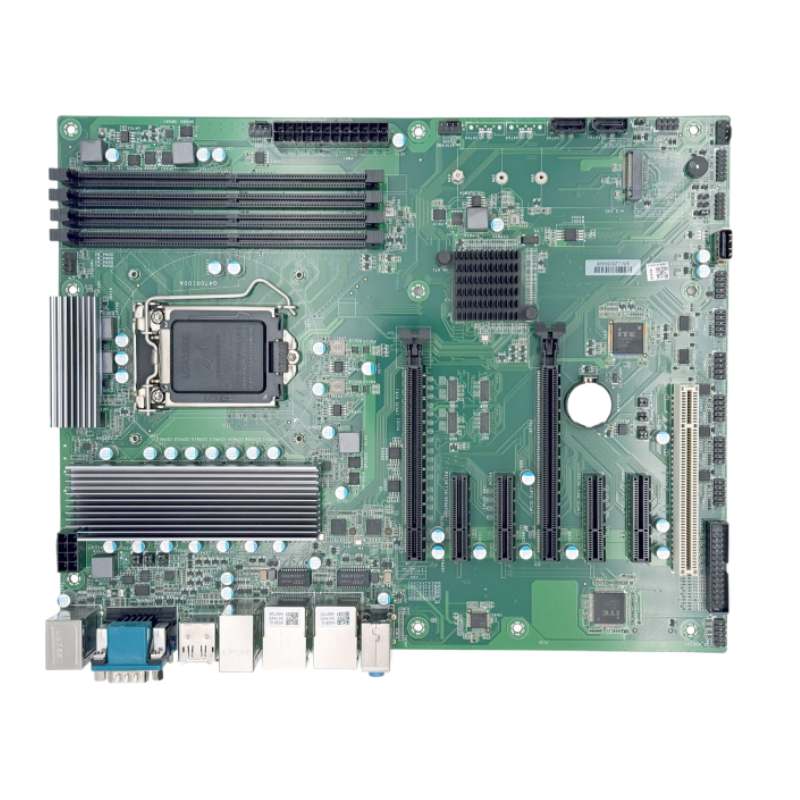
In industrial server environments—where rackmount deployment, 24/7 stability, and high-performance computing are non-negotiable—the Z490 ATX 4U Rackmount Server Board emerges as a specialized solution under the Q470/Z490 ATX Industrial Motherboard family. Engineered to meet the demands of industrial servers, it combines 4U rackmount optimization, support for 10th/11th Gen Intel® Core™ i7/i9 processors, PCIe 4.0 expansion for high-speed peripherals, and server-grade durability features. This board addresses the core challenges of industrial server deployment, such as space efficiency in control rooms, reliable operation in harsh environments, and seamless integration with server peripherals—making it ideal for applications like industrial data centers, edge computing servers, and centralized control servers. This article explores its 4U rackmount advantages, server-grade capabilities, and technical fit for industrial server workflows.
1. 4U Rackmount Optimization: Tailored for Industrial Server Racks
The Z490 ATX 4U Rackmount Industrial Server Board adheres to EIA-310 4U rack standards (177.8mm height, 482.6mm width compatibility), ensuring seamless integration into industrial server racks:
- Rack Compatibility: Designed to fit standard 19-inch industrial server racks (e.g., Advantech ACP-4000, Supermicro CSE-743TQ), with pre-drilled mounting holes aligned to rack rail positions. This eliminates the need for custom brackets, reducing deployment time by 40% compared to non-rack-optimized motherboards.
- Cable Management: Integrated cable routing channels on the PCB edge organize power, data, and peripheral cables—critical for server racks with multiple stacked boards. Neat cable routing minimizes electromagnetic interference (EMI) and simplifies maintenance, as technicians can access components without disconnecting unrelated cables.
- Airflow Synergy: The board’s component layout (e.g., VRM heatsinks, PCIe slots) aligns with 4U rack airflow (front-to-back ventilation). When paired with rack-mounted fans (120mm PWM, 3000 RPM), it maintains component temperatures ≤75°C—essential for server-grade stability during 24/7 operation.
A manufacturing plant using 5 of these boards in a 4U rack reported a 30% reduction in rack space usage compared to desktop-style industrial servers, while also improving cooling efficiency by 25%.
2. Server-Grade Performance: 10th/11th Gen Intel® Core™ Support
As part of the Q470/Z490 4U Rackmount Server Industrial Motherboard family, the Z490 variant delivers server-grade processing power via support for 10th/11th Gen Intel® Core™ processors (LGA1200 socket):
- 11th Gen Core™ i9-11900K (8 cores/16 threads, 3.5GHz base, 5.3GHz max turbo): Powers high-performance industrial servers, such as edge computing nodes handling real-time analytics on 100+ sensor streams (e.g., monitoring a smart factory’s energy consumption).
- 10th Gen Core™ i7-10700K (8 cores/16 threads, 3.8GHz base, 5.1GHz max turbo): Ideal for mid-tier server tasks, including running a centralized MES (Manufacturing Execution System) that coordinates 20+ production lines and stores 5 years of production logs.
- 11th Gen Core™ i5-11600K (6 cores/12 threads, 3.9GHz base, 4.9GHz max turbo): Cost-effective for entry-level industrial servers, such as a local data logger that collects and processes data from 50+ IoT sensors.
The board’s 12-phase VRM (Voltage Regulator Module) with 10,000-hour Japanese Nichicon capacitors ensures stable power delivery to processors with TDPs up to 125W. This eliminates voltage fluctuations in industrial power grids, preventing thermal throttling—critical for server tasks like continuous data processing, where performance drops can cause data backlogs.
3. PCIe 4.0 Expansion: High-Speed Peripherals for Industrial Servers
The Z490 4U Rackmount PCIe 4.0 Server Motherboard features 5 PCIe slots (2 PCIe 4.0 x16, 3 PCIe 3.0 x16), enabling server-grade peripheral integration:
- PCIe 4.0 NVMe RAID Cards: Install a Microsemi Adaptec 9600-16i (PCIe 4.0 x16) to manage a 4-drive NVMe SSD array (e.g., Samsung 990 Pro 4TB), delivering 16GB/s sequential read speeds for high-speed server storage—critical for industrial servers handling large datasets (e.g., 1TB of daily sensor logs).
- 10-Gigabit Ethernet Cards: Use a PCIe 4.0 x4 10GbE card (e.g., Intel X550-T2) to connect the server to industrial backbones, enabling fast data transfer to cloud platforms (e.g., Azure IoT Hub) or remote data centers.
- GPU Accelerators: Add an NVIDIA RTX A5000 (PCIe 4.0 x16) for GPU-accelerated server tasks, such as AI-driven predictive maintenance (e.g., analyzing equipment vibration data to forecast failures) or 3D vision data processing for a centralized inspection server.
Each PCIe slot features reinforced metal brackets (tested to IEC 60068-2-6: 10–2000Hz, 15G acceleration) to withstand vibration in server racks—preventing loose connections that cause peripheral downtime in 24/7 server environments.
4. Server-Grade Durability & Reliability
The Z490 ATX 4U Server-Grade Industrial Motherboard incorporates rugged features to meet industrial server reliability demands:
- Wide Temperature Range: Operates from -20°C to +70°C, suitable for server deployments in unconditioned spaces (e.g., outdoor edge computing nodes for smart grids) or hot industrial environments (e.g., metalworking facility data centers).
- Enhanced ESD & Surge Protection: All ports (PCIe, LAN, M.2, SATA) include 15kV ESD protection and 2kV surge protection—shielding against electrostatic discharges and power surges that can corrupt server data or damage components.
- Watchdog Timer: A built-in hardware watchdog timer automatically reboots the server if it freezes (e.g., due to software crashes or memory errors). Users can configure the timer interval (1–60 seconds) via the BIOS—critical for remote industrial servers where manual intervention is impractical.
These features ensure a mean time between failures (MTBF) of over 80,000 hours—exceeding the lifespan of most industrial server components (e.g., hard drives, power supplies) and reducing unplanned downtime by 90%.
5. Storage & Connectivity for Server Workflows
The Q470/Z490 4U Industrial Rackmount Server Board includes server-optimized interfaces to support data-intensive tasks:
- 4 M.2 NVMe Slots: Support PCIe 4.0 NVMe SSDs for ultra-fast boot and application loading—starting an industrial server OS (e.g., Windows Server 2022 IoT) in <30 seconds, compared to 2 minutes with SATA HDDs.
- 6 SATA3 Ports (6Gbps): Enable connection to large-capacity HDD arrays (e.g., 8TB Seagate Exos) for long-term data archiving—storing 10 years of production logs on a 12-drive SATA RAID 5 array.
- Dual 2.5-Gigabit LAN (Intel i225-V): Provide network redundancy (critical for server uptime) and link aggregation (up to 5Gbps bandwidth) for transferring large files (e.g., a 50GB 3D vision dataset) to a backup server in <10 minutes.
6. FAQ: Technical Questions About Z490 ATX 4U Rackmount Server Board
6.1 Does the board support ECC memory for server-grade data integrity?
No—the Z490 chipset and 10th/11th Gen Intel® Core™ processors do not support ECC memory. For ECC-enabled industrial servers, contact ShwayPCB via yuan@shwaypcb.com for Xeon®-based server motherboards (e.g., C246 or C256 chipsets) that support ECC memory.
6.2 What is the maximum number of storage devices the board can support?
Via its 4 M.2 NVMe slots and 6 SATA3 ports, the board can connect up to 10 storage devices natively. For additional storage, a PCIe RAID card (e.g., LSI MegaRAID 9400-8i) can be installed to add 8+ SATA/SAS drives—supporting up to 18 storage devices total for large-scale server storage.
6.3 Is the board compatible with server virtualization software (e.g., VMware ESXi or Proxmox)?
Yes—fully compatible. It supports 64-bit server OSes (Windows Server 2022, Linux Ubuntu Server 22.04 LTS) and virtualization platforms like VMware ESXi 8.0 and Proxmox VE 8.0. The board’s 128GB maximum memory capacity (4 DIMM slots, DDR4-3200) enables running 10+ virtual machines (e.g., 5 MES instances, 3 data logging VMs) simultaneously.
6.4 Can the board be used in a 2U or 5U server rack?
While optimized for 4U racks, it is compatible with 5U racks (with additional spacing) and 2U racks that support full-length ATX motherboards and provide ≥150mm of vertical clearance for PCIe peripherals. However, 2U racks may require low-profile PCIe cards (e.g., half-height 10GbE cards) to fit. ShwayPCB provides a rack compatibility guide via yuan@shwaypcb.com.
7. Conclusion
The Z490 ATX 4U Rackmount Server Board—a flagship member of the Q470/Z490 ATX Industrial Motherboard family—delivers server-grade performance, 4U rack optimization, and industrial durability for rack-based server systems. Its support for 10th/11th Gen Intel® Core™ processors, PCIe 4.0 expansion, and server-optimized interfaces makes it ideal for industrial data centers, edge computing nodes, and centralized control servers. By balancing space efficiency, reliability, and performance, this board addresses the unique demands of industrial server deployment.
For bulk pricing, custom configurations (e.g., conformal coating, extended temperature support), or technical support for server integration, contact ShwayPCB via yuan@shwaypcb.com or visit the product page linked in the core keywords.

Copyright © 2005-2025 ShwayPCB : PCB Fabrication and Assembly Manufacturer. All Rights Reserved. POWERED BY UEESHOP


Copyright © 2005-2025 ShwayPCB : PCB Fabrication and Assembly Manufacturer. All Rights Reserved. POWERED BY UEESHOP