
High-Precision Personnel Positioning in Coal Mines and Tunnels: A Detailed Explanation of the TOF One-Dimensional Positioning Scheme Based on UWB Technology
High-Precision Personnel Positioning in Coal Mines and Tunnels: A Detailed Explanation of the TOF One-Dimensional Positioning Scheme Based on UWB Technology
In complex operational scenarios such as coal mines, pipe galleries, and tunnels, the country has imposed stringent requirements for intelligent transformation, especially in terms of personnel positioning. Silicon Transmission Technology has introduced a TOF one-dimensional positioning scheme based on UWB technology to meet the high-precision personnel location and environmental perception needs in these scenarios, thereby aiding the intelligent development of related industries.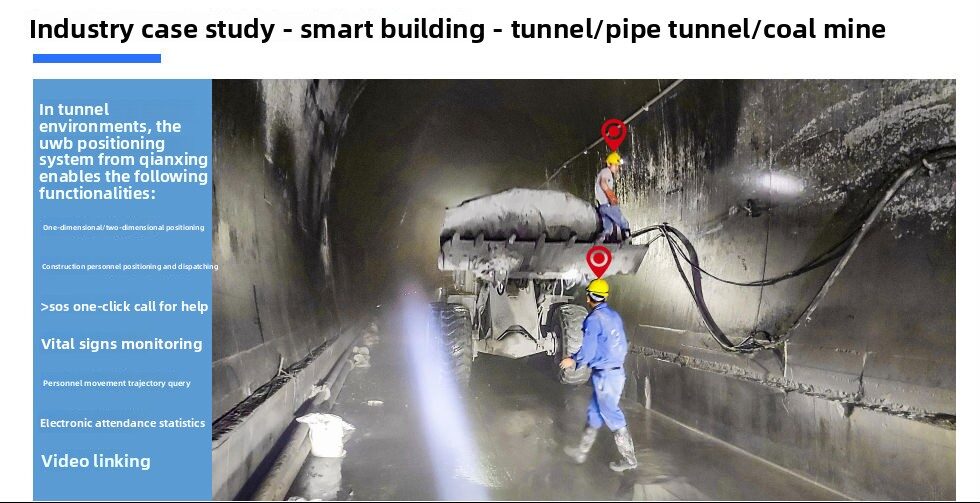
I. System Composition
This scheme consists of UWB base stations, UWB tags, UWB positioning engine algorithms, and UWB positioning software.
II. Working Principle
In the tunnel positioning system, positioning tags worn by personnel or attached to items emit UWB pulse signals to transmit location data. The positioning base stations receive these signals and calculate the distance between the tag and the base station using the signal flight time. Based on this, the positioning engine collects distance data from different base stations and tags, calculates the current position of the tag, and displays it in real time.
III. Scheme Advantages
(A) Precise Positioning
The positioning accuracy is less than 30cm, with an average accuracy reaching the centimeter level. It can provide extremely accurate location information for personnel and materials.
(B) Long-Distance Coverage
The effective coverage distance of UWB base stations reaches 400m, and the one-dimensional positioning coverage range can exceed 800 meters. In open environments, one base station can be installed every 800m.
(C) Efficient Personnel Management
It can conduct real-time statistical identification of on-site personnel and intelligently trace personnel trajectories, facilitating comprehensive monitoring of personnel dynamics by managers.
(D) Timely Emergency Assistance
When personnel encounter danger, pressing the alarm button on the tag can report the situation to the management platform, which can respond and handle it promptly. If the platform detects a dangerous situation, it can also issue emergency evacuation signals to notify personnel in the corresponding area to take evasive action.
(E) Flexible Electronic Fencing
The platform can define electronic fences for safe zones and access control based on the actual working conditions in the tunnel. Entering these fences triggers corresponding levels of alarms. It can also draw polygonal fences, integrate with access permissions, and form flexible fence rules.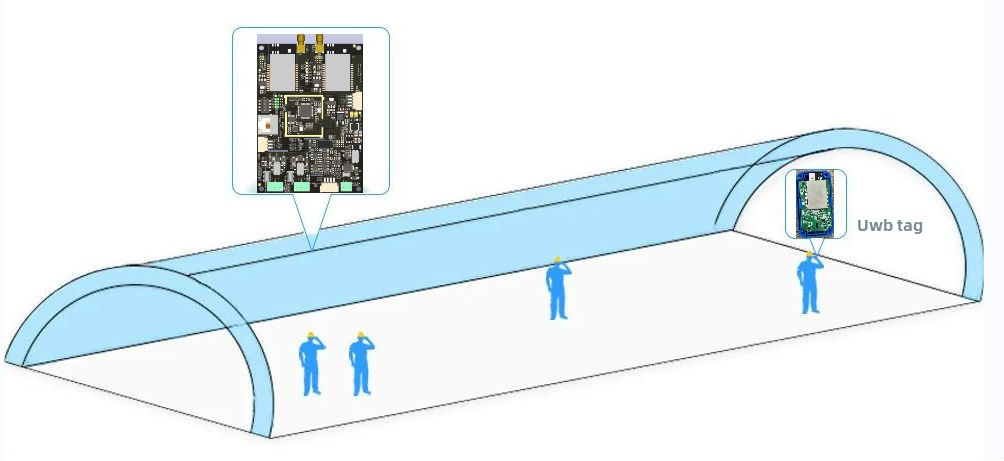
IV. Key Points of One-Dimensional Positioning
(A) Applicable Scenarios
It is suitable for narrow spaces with limited width, such as mine roadways and tunnels.
(B) Base Station Deployment
One base station should be installed every 800m (in open environments) to achieve a positioning accuracy of less than 30cm. If there are significant bends or turns in the roadway/tunnel, additional base stations should be installed for compensation. A single base station can achieve clear one-dimensional positioning (direction determination). The dual-base station version is shipped as PCBA by default.
V. System Functions
(A) Real-Time Location Display and Monitoring
It can track the movement trajectory of individual personnel and search/filter personnel location information through statistical lists.
(B) Convenient System Management
It supports map display, real-time monitoring of base station working status, and configuration of various functional parameters.
(C) Flexible Intelligent Attendance
It allows for custom drawing of attendance areas, setting departmental attendance schedules, automatically determining late arrivals and early departures, generating attendance reports, and recording clock-in and clock-out times as well as on-duty durations.
(D) Comprehensive Organizational Structure and Personnel Management
It supports customization of organizational structures, easy management of departmental hierarchies, and features low-battery alerts, paging/SOS recording functions.
(E) Intelligent Trajectory Playback
It can flexibly filter and playback trajectories based on personnel, time periods, and regions, intelligently filter out time periods without positioning data, and support multi-target, multi-speed playback of historical trajectories.
(F) Reliable Automatic Inspection
The inspection area can automatically report repairs. It solves the problem of personnel on-site presence through precise positioning and facial recognition, eliminating missed inspections and false records, and achieving visual closed-loop management of process status.
(G) Rapid Emergency Calling
In emergency situations, employees can press and hold the "emergency call" button on the tag to send a distress signal. The management software receives the signal and prompts supervisors to handle it. Supervisors can also click on the evacuation instruction, select a region, and send an evacuation instruction to employees. The tag will then emit sound and light alarms to prompt personnel to evacuate.
VI. Conclusion
UWB positioning technology offers advantages such as low power consumption, insensitivity to channel fading, strong anti-interference capabilities, non-interference with other devices, and strong penetration. It demonstrates high positioning accuracy and precision in personnel positioning for coal mines and tunnels, providing a solid guarantee for safe production.


