
High-Precision Personnel Positioning in Coal Mines and Tunnels: A Comprehensive Overview of the TOF One-Dimensional Positioning Solution Based on UWB Technology
High-Precision Personnel Positioning in Coal Mines and Tunnels: A Comprehensive Overview of the TOF One-Dimensional Positioning Solution Based on UWB Technology
In complex and hazardous work environments such as coal mining and tunnel construction, ensuring personnel safety and efficient management is of paramount importance. As the country raises requirements for the intelligent transformation of various complex work scenarios, precise and reliable personnel positioning systems have become crucial for ensuring safe production. The TOF one-dimensional positioning solution based on UWB technology, introduced by Silicon Transmission Technology, provides a high-precision personnel location and environmental perception solution for coal mines, tunnels, and other scenarios, significantly driving the intelligent advancement of related industries.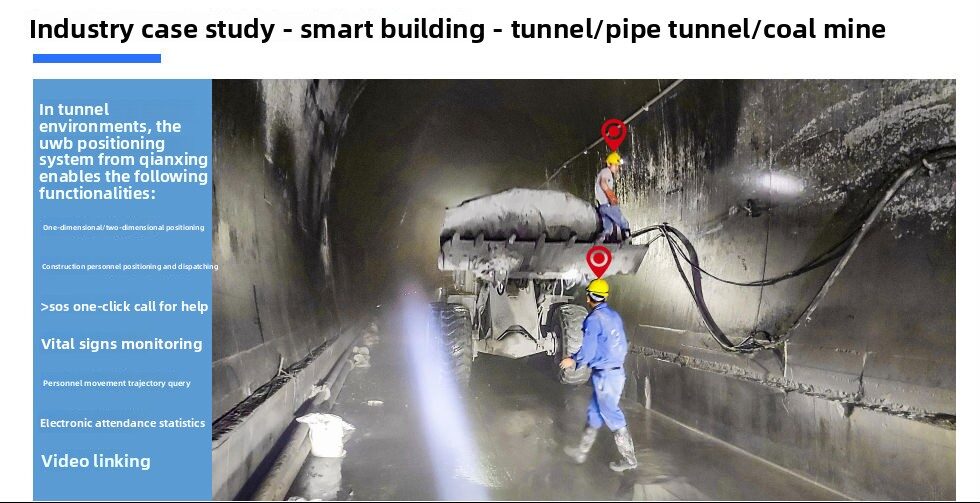
I. Solution Architecture: A Collaborative Positioning System with Multiple Components
This solution consists of UWB base stations, UWB tags, UWB positioning engine algorithms, and UWB positioning software. These components work closely together to achieve precise positioning of personnel and materials.
- UWB Base Stations: As the core receiving devices of the positioning system, they are responsible for receiving signals emitted by UWB tags and serve as key nodes for acquiring location data.
- UWB Tags: Carried by personnel or materials, these tags transmit UWB pulse signals, conveying their own location information to the base stations.
- UWB Positioning Engine Algorithms: These algorithms process and analyze the signals received by the base stations. Based on parameters such as the time-of-flight of the signals, they accurately calculate the position of the tags.
- UWB Positioning Software: It provides an intuitive user interface, enabling visualization of positioning data, system management, and function configuration. This facilitates easy operation and monitoring by management personnel.
II. Working Principle: Positioning Through Time-of-Flight Measurement of Signals
In the tunnel positioning system, the positioning process is based on the precise measurement of the time-of-flight (TOF) of signals. The UWB positioning tags worn by personnel or items continuously emit UWB pulse signals containing the tag's location data. Upon receiving these signals, the positioning base stations measure the time it takes for the signals to travel from the tag to the base station. By combining this with the known signal propagation speed, they accurately calculate the distance between the tag and the base station. The positioning engine then collects distance data from different base stations and the tag, using specific algorithms to precisely calculate the tag's position at the current moment. The results are displayed in real-time on the positioning software interface, allowing management personnel to keep track of the dynamic positions of personnel and materials at all times.
III. Solution Characteristics: Meeting High Requirements in Complex Scenarios
(A) Ultra-High Precision Positioning
This solution achieves an average positioning accuracy at the centimeter level, with a positioning accuracy of less than 30 cm. It provides extremely precise location information for personnel and materials in coal mines and tunnels. Whether in narrow roadways or complex tunnel structures, it can achieve accurate positioning, effectively preventing safety accidents and management chaos caused by inaccurate positioning.
(B) Long-Distance and Stable Coverage
UWB base stations have excellent signal coverage capabilities, with an effective coverage distance of up to 400 m. In one-dimensional positioning mode, the coverage range can be extended to over 800 meters. In open environments, installing one base station every 800 m can meet the positioning requirements, significantly reducing the number of base stations needed for deployment and lowering system construction and maintenance costs.
(C) Flexible Adaptation to Complex Environments
This solution is highly adaptable to complex terrains commonly found in coal mines and tunnels, such as bends and turns. When there are large bends or turns in roadways or tunnels, simply adding UWB base stations for positioning compensation can ensure that the positioning accuracy remains unaffected. Additionally, a single base station can achieve clear one-dimensional positioning, accurately determining the direction of movement of personnel and materials, providing reliable data for management decisions.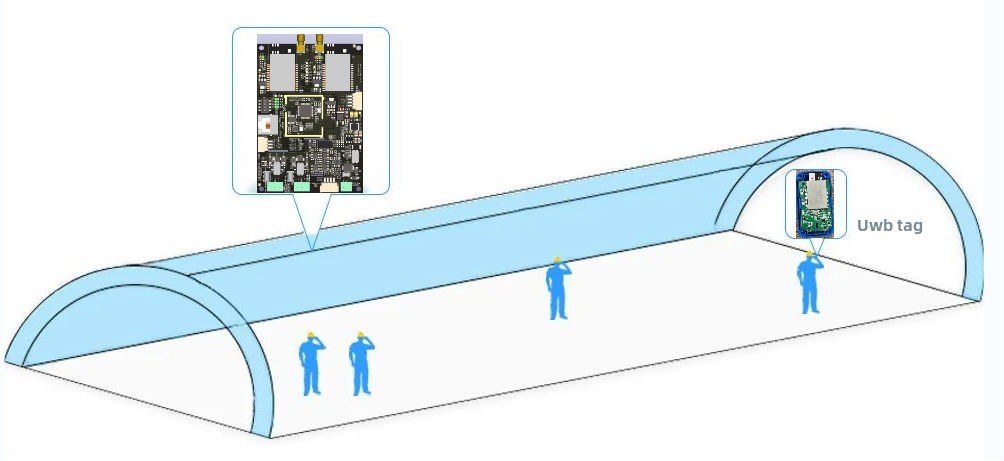
IV. Functional Highlights: Comprehensive Safety and Management Guarantees
(A) Real-Time Personnel Management and Trajectory Tracing
The system can statistically analyze and identify on-site personnel in real-time, allowing management personnel to view personnel location information at any time. The intelligent personnel trajectory tracing function records the action routes of personnel within a certain period, providing detailed data support for accident investigations, personnel scheduling, and other purposes.
(B) Rapid Response to Dangerous Situations
In case of dangerous situations, workers only need to press the alarm button on the tag, and the distress signal will be immediately reported to the management platform. Upon receiving the signal, the management platform will promptly display a pop-up window to alert regulatory personnel for processing, ensuring that rescue operations can be initiated promptly. Moreover, when the platform detects a dangerous situation, it can also send out an emergency evacuation signal. By simply selecting the area to be evacuated with the mouse, the software backend will send evacuation instructions to employees in that area. When the employees' tags receive the instructions, they will issue audible and visual alarms to prompt personnel to evacuate the dangerous area urgently.
(C) Flexible Electronic Fence Settings
The platform can flexibly define safety zone electronic fences and access control electronic fences based on the actual working conditions in tunnels. When personnel enter or leave the electronic fence areas, alarms of corresponding levels will be triggered, effectively preventing personnel from accidentally entering dangerous areas. Additionally, the system supports drawing polygonal fences and integrating them with permission management. Through three conditions—entry, stay, and exit—it forms flexible fence rules to meet the safety management needs of different scenarios.
(D) Intelligent Attendance and Organizational Management
The system features intelligent attendance functions, allowing for the custom drawing of attendance areas and the setting of departmental attendance shifts. It can automatically determine employees' tardiness and early departures and generate detailed attendance reports, recording employees' check-in and check-out times as well as their on-duty durations. This provides accurate data for human resource management. Furthermore, the system supports custom organizational structure definitions, facilitating the management of departmental hierarchies. It also offers functions such as low-battery reminders and paging/SOS records, enhancing organizational management efficiency and safety.
(E) Trajectory Playback and Automatic Inspection
The trajectory playback function allows for flexible screening of personnel action trajectories based on conditions such as personnel, time periods, and areas. It intelligently filters out time periods without positioning data and supports multi-target, multi-speed playback of historical trajectories, facilitating post-event analysis and investigations by management personnel. The automatic inspection function enables automatic reporting of maintenance needs in inspection areas. Through precise positioning and facial recognition technology, it addresses the issue of personnel on-site presence, eliminating missed inspections and false documentation, and achieving a visual closed-loop management of the inspection process.
V. Technological Advantages: The Unique Charm of UWB Positioning
UWB positioning technology offers numerous significant advantages, making it outstanding in personnel positioning for coal mines and tunnels.
- Low Power Consumption: UWB tags have low power consumption, extending their usage time and reducing the hassle of frequent battery replacements, thereby lowering maintenance costs.
- Strong Anti-Interference Capability: It is insensitive to channel fading (such as multipath and non-line-of-sight channel conditions), enabling stable operation in complex electromagnetic environments and ensuring the accuracy and reliability of positioning data.
- No Interference with Other Devices: It does not interfere with other devices in the same environment, ensuring the normal operation of other communication and monitoring systems in coal mines and tunnels.
- Strong Penetration Ability: It has strong penetration capabilities and can perform positioning in environments with one brick wall penetration, adapting to the complex physical environments in coal mines and tunnels.
VI. Conclusion
The TOF one-dimensional positioning solution based on UWB technology provides an efficient, precise, and reliable personnel positioning solution for the coal mining and tunnel industries. With its exceptional positioning accuracy, long-distance coverage capabilities, rich functional features, and unique technological advantages, this solution can effectively ensure safe production in coal mines and tunnels, improve management efficiency, and drive the intelligent and safe development of related industries. As technology continues to advance and application scenarios expand, UWB positioning technology will play a more significant role in more fields, bringing greater convenience and safety guarantees to people's production and lives.
UWB Positioning System Products


