We use cookles to Improve your online experience. By continuing browsing this website, we assume you agree our use of cookies.

What Is EMS for PCB? A Technical Guide to PCB-Focused Electronic Manufacturing Services
August 31st, 2025
285 views
What Is EMS for PCB? A Technical Guide to PCB-Focused Electronic Manufacturing Services
EMS for PCB—short for Electronic Manufacturing Services specialized in Printed Circuit Boards—refers to a dedicated suite of technical services that support the entire lifecycle of PCB production: from optimizing PCB designs for manufacturability to assembling components, testing functionality, and ensuring compliance with industry standards. Unlike general EMS (which may handle full-system manufacturing), EMS for PCB zeroes in on the unique challenges of PCB production—such as miniaturization, solder joint reliability, and compatibility with surface mount (SMT) or through-hole (THT) components.
For businesses developing electronic devices (e.g., IoT sensors, automotive ECUs, medical monitors), EMS for PCB acts as a technical partner that bridges the gap between digital PCB designs (Gerber files, Bill of Materials/BOM) and physical, production-ready PCBs. ShwayPCB’s electronics manufacturing services exemplify this focus, offering PCB-specific solutions like high-precision SMT assembly for 0.3mm-pitch BGAs and functional testing for automotive-grade PCBs.
1. Core Technical Services of EMS for PCB
EMS for PCB is built around 5 interconnected technical services, each addressing a critical stage of PCB production:
1.1 PCB Design-for-Manufacturability (DFM) Optimization
Before manufacturing, EMS for PCB providers refine client PCB designs to avoid production defects and reduce costs—critical for high-complexity PCBs (e.g., 12-layer automotive infotainment PCBs):
- Component Compatibility Checks: Ensure components (e.g., MLCCs, RF ICs) fit within PCB footprint constraints and are compatible with assembly processes (e.g., reflow oven temperatures). For example, if a client’s IoT sensor PCB specifies a component with a 0.2mm pitch that’s incompatible with standard SMT equipment, EMS engineers will recommend a drop-in alternative with a 0.3mm pitch—using their expertise in PCB assembly service.
- Material Selection Guidance: Advise on PCB substrate choices (e.g., high-Tg FR4 for thermal stability, polyimide for flexible PCBs) based on the device’s end-use (e.g., -40°C to +125°C for automotive PCBs).
- Layout Adjustments: Optimize trace routing to minimize signal crosstalk (critical for 5G PCBs) and adjust copper weight (e.g., 2oz for power PCBs) to meet current-carrying requirements.
1.2 PCB Fabrication Support
While some EMS providers outsource PCB fabrication to specialized facilities, full-service EMS for PCB partners (like ShwayPCB) manage fabrication in-house or via trusted suppliers—ensuring quality control:
- Prototype Fabrication: Produce small-batch PCBs (1–50 units) for R&D testing, with turnaround times of 2–5 days via quickturn prototype services.
- Mass Production Oversight: Monitor large-scale PCB fabrication (10k+ units) to ensure consistency in substrate thickness (±0.1mm), copper plating uniformity, and solder mask alignment—critical for high-volume SMT PCB assembly.
1.3 SMT & Mixed-Technology Assembly
Surface Mount Technology (SMT) is the backbone of modern PCB assembly, and EMS for PCB providers specialize in configuring SMT lines for PCB-specific needs:
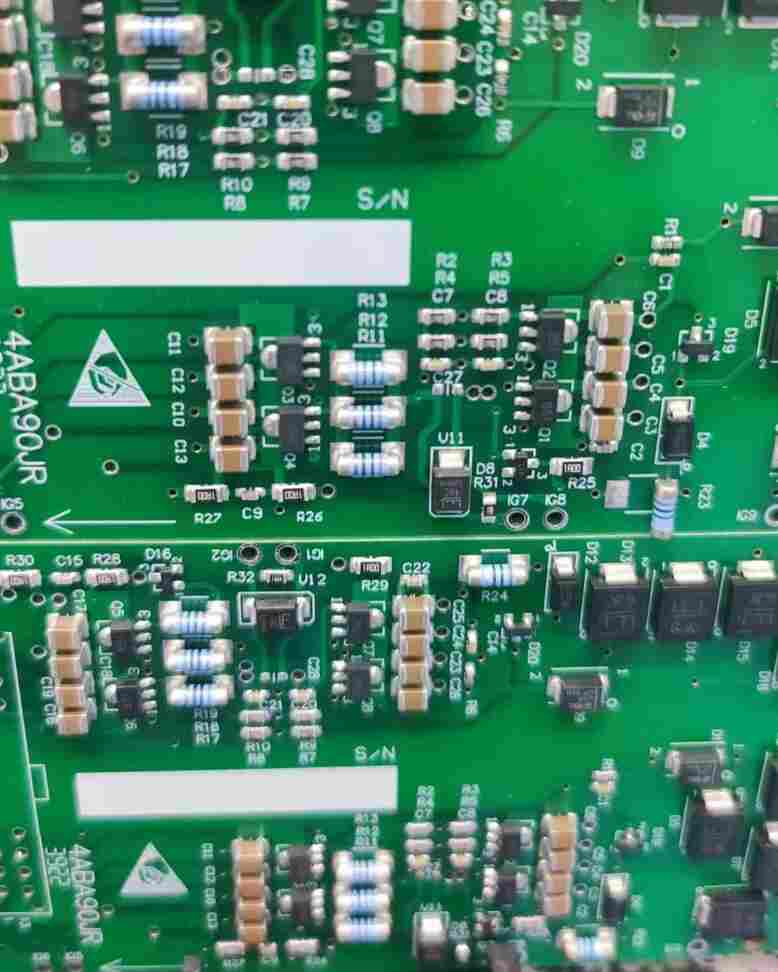
- High-Precision SMT Assembly: Use automated pick-and-place machines (e.g., Yamaha YSM40R, Fuji NXT III) to place tiny components (down to 01005 size, 0.4mm×0.2mm) onto PCBs with ±0.015mm accuracy. This is essential for dense PCBs like 5G modem boards, where component spacing is as small as 0.1mm.
- Mixed-Technology Assembly: Integrate SMT and Through-Hole (THT) assembly for PCBs requiring both (e.g., industrial controllers with THT power connectors and SMT sensors). EMS providers use hybrid lines that first complete SMT assembly, then use automated insertion machines for THT components—ensuring reliability in harsh environments.
- ShwayPCB’s Capability: Our electronics manufacturing services include SMT lines with 8MP vision systems and nitrogen reflow ovens—ideal for soldering heat-sensitive components (e.g., OLED drivers) on consumer electronics PCBs.
1.4 PCB Testing & Quality Assurance
EMS for PCB providers implement rigorous testing to ensure PCBs meet performance and safety standards—critical for industries like medical and automotive:
- In-Process Testing:
- AOI (Automated Optical Inspection): Use 5MP+ cameras to detect SMT defects (bridging, tombstoning, missing components) with 99.8% accuracy.
- X-Ray Inspection: Verify BGA and CSP solder joints (detecting voids <5%)—essential for PCBs with hidden components (e.g., automotive ADAS PCBs).
- Functional Testing: Validate PCB performance against client specs (e.g., signal integrity for 5G PCBs, power efficiency for IoT sensors). For example, a medical PCB might undergo 1,000 hours of continuous operation testing to meet ISO 13485 standards.
- Environmental Testing: Subject PCBs to thermal cycling (-40°C to +125°C for automotive), humidity testing (85°C/85% RH for industrial), and vibration testing (MIL-STD-883 for aerospace)—ensuring durability in end-use environments.
1.5 Supply Chain & Logistics for PCB Components
EMS for PCB streamlines the complex supply chain for PCB components, mitigating risks like shortages or counterfeits:
- Component Sourcing: Leverage relationships with 200+ authorized distributors (e.g., Avnet, Arrow) to source PCB-specific components (e.g., AEC-Q100 automotive ICs, RoHS-compliant passives) at competitive prices. During global shortages (e.g., semiconductor crunches), EMS providers like ShwayPCB use strategic stockpiling to ensure continuity for high-volume SMT PCB assembly.
- Just-in-Time (JIT) Delivery: For clients with seasonal demand (e.g., consumer electronics PCBs for holiday sales), EMS offers JIT production to reduce inventory costs while ensuring on-time delivery.
2. Why Businesses Choose EMS for PCB Over In-House Production
For most companies, EMS for PCB is more cost-effective and technically reliable than in-house PCB manufacturing—here’s why:
2.1 Access to Specialized PCB Equipment
PCB manufacturing requires expensive, niche equipment that most businesses cannot justify purchasing:
- SMT Lines: A single high-precision SMT line (pick-and-place + reflow oven + AOI) costs \(500k–\)2M—prohibitive for startups or SMEs.
- Testing Tools: 3D X-ray machines for BGA inspection cost \(150k–\)300k, while thermal cycling chambers for environmental testing add \(100k–\)200k.
- EMS Advantage: ShwayPCB’s electronics manufacturing services spread these costs across hundreds of clients, making advanced PCB equipment accessible to businesses of all sizes.
2.2 Technical Expertise in PCB-Specific Challenges
PCB production has unique technical hurdles that in-house teams often lack the expertise to solve:
- Miniaturization: Assembling 01005 components or 0.3mm-pitch BGAs requires specialized training and equipment—EMS engineers average 5+ years of experience in high-precision SMT assembly.
- Compliance: Navigating PCB-specific standards (e.g., IPC-A-610 for assembly, AEC-Q100 for automotive) is time-consuming—EMS providers manage compliance end-to-end, saving clients 3–6 months of certification work.
2.3 Scalability for PCB Production
EMS for PCB adapts to fluctuating demand, a critical advantage for businesses with growing or seasonal PCB needs:
- Prototype to Mass Production: A startup can begin with 50 prototype PCBs via quickturn prototype services, then scale to 100k units/month within 6 months—without investing in additional equipment.
- Seasonal Adjustments: A consumer electronics brand can increase PCB production by 50% for holiday sales, then scale back—EMS providers handle overtime shifts and temporary line additions.
2.4 Cost Savings Through Efficiency
EMS for PCB reduces costs via:
- Economies of Scale: Bulk component sourcing cuts material costs by 10–15% vs. individual purchases.
- Waste Reduction: DFM optimization reduces PCB scrap rates from 5–10% (in-house) to <1% (EMS).
- Labor Savings: EMS automates 80–90% of PCB assembly (vs. 30–40% for in-house), reducing labor costs by 40–50%.
3. EMS for PCB Applications Across Industries
EMS for PCB is tailored to industry-specific PCB requirements, with technical adjustments to meet unique challenges:
3.1 Automotive PCB
- Key Requirements: AEC-Q100 compliance, thermal stability (-40°C to +125°C), vibration resistance.
- EMS Services: High-reliability PCB assembly, X-ray inspection of BGA solder joints, thermal cycling testing.
- Example: ShwayPCB assembles automotive ECU PCBs with 100% AOI/X-ray testing and conformal coating to protect against engine bay heat.
3.2 Medical PCB
- Key Requirements: ISO 13485 compliance, traceability, sterility.
- EMS Services: Serialized component tracking, cleanroom assembly, 1,000-hour functional testing.
- Example: A medical device client uses ShwayPCB to produce ECG monitor PCBs—each with a unique serial number linked to component lot data for FDA recall management.
3.3 5G & Wireless PCB
- Key Requirements: High-frequency performance (up to 40GHz), low signal loss, miniaturization.
- EMS Services: High-precision SMT assembly for RF components, signal integrity testing, high-Tg FR4 substrate support.
- Example: ShwayPCB manufactures 5G small cell PCBs with <0.1dB insertion loss at 28GHz—meeting 3GPP 5G NR standards.
3.4 Industrial PCB
- Key Requirements: Long lifespan (10+ years), EMI resistance, ruggedization.
- EMS Services: Conformal coating, EMI shielding, extended temperature testing (-55°C to +150°C).
- Example: An industrial client partners with ShwayPCB to produce IoT sensor PCBs for factory floors—with IP65-rated enclosures and vibration testing to MIL-STD-883.
4. FAQ: EMS for PCB
1. Can EMS for PCB handle both prototype and mass-production runs?
Yes—this is a core strength of EMS for PCB. ShwayPCB offers:
- Quickturn Prototypes: 2–5 day turnaround for 1–50 PCB units via quickturn prototype services—ideal for R&D testing.
- Mass Production: Scalable lines for 10k–1M+ PCBs/month, with JIT delivery to reduce inventory costs.
- Seamless Transition: Prototypes and mass-production PCBs are manufactured using the same equipment and processes—ensuring no design or quality gaps between stages.
2. What technical documents do clients need to provide for EMS for PCB?
Clients typically need 4 key documents:
- Gerber Files: Detailed PCB layout files (layers, traces, pads, solder mask).
- Bill of Materials (BOM): Component part numbers, quantities, and suppliers (if specified).
- Assembly Drawings: Component placement diagrams, torque specifications for THT parts, and test points.
- Test Specifications: Functional test protocols (e.g., voltage ranges, signal thresholds) and acceptable defect rates.
ShwayPCB provides a technical checklist to help clients prepare these documents—available via its electronics manufacturing services page.
3. How does EMS for PCB ensure component quality (e.g., avoiding counterfeit ICs)?
EMS for PCB uses 3 layers of quality control for components:
- Authorized Sourcing: Components are sourced only from official distributors (e.g., Avnet, Arrow) with traceability to the manufacturer.
- Incoming Inspection: Each component lot undergoes visual checks (e.g., verifying logos, part numbers) and electrical testing (for critical ICs) to detect counterfeits.
- Blockchain Traceability: For high-value PCBs (e.g., medical, aerospace), EMS providers use blockchain to track components from supplier to finished PCB—ensuring authenticity and recallability.
4. What is the cost difference between EMS for PCB and in-house production?
EMS for PCB typically costs 15–30% less than in-house production for mid-to-high volume runs (1k+ units). For example:
- In-House: A 10k-unit run of IoT PCBs might cost $15/unit (equipment depreciation + labor + materials).
- EMS for PCB: The same run costs \(10–\)12/unit (no depreciation, bulk material savings, automated labor).
- Small Runs: For 100-unit prototypes, EMS (\(25–\)30/unit) is more cost-effective than in-house (\(50–\)60/unit)—as in-house setup costs dominate small batches.
5. How does ShwayPCB’s EMS for PCB support clients with unique requirements (e.g., flexible PCBs)?
ShwayPCB offers customized EMS for PCB solutions:
- Flexible PCBs: Specialized SMT lines for flexible substrates (polyimide), with tension control to prevent bending damage during assembly.
- High-Voltage PCBs: Insulation testing (up to 10kV) and copper spacing optimization for PCBs used in EV chargers or industrial power supplies.
- Custom Testing: Tailored test protocols (e.g., RF testing for 5G PCBs, thermal imaging for high-power PCBs) to meet client-specific performance goals.
5. Conclusion
EMS for PCB is a specialized, technical solution that turns PCB designs into functional, reliable products—addressing the unique challenges of PCB production (miniaturization, compliance, scalability) that most businesses cannot solve in-house. By leveraging services like high-precision SMT assembly, DFM optimization, and end-to-end testing, EMS for PCB enables businesses to focus on innovation while ensuring their PCBs meet industry standards and market demands.
ShwayPCB’s electronics manufacturing services are built for PCB-focused clients, with capabilities spanning prototype to mass production and industries from automotive to medical. Our team of PCB experts works closely with you to understand your design goals and deliver customized solutions that meet quality, cost, and timeline requirements.
To discuss your PCB project, request a prototype quote, or learn more about our technical capabilities (e.g., flexible PCB assembly, 5G signal testing), contact ShwayPCB at yuan@shwaypcb.com. For detailed case studies (e.g., automotive PCB production, medical device assembly), visit our dedicated EMS service page.

Copyright © 2005-2025 ShwayPCB : PCB Fabrication and Assembly Manufacturer. All Rights Reserved. POWERED BY UEESHOP


Copyright © 2005-2025 ShwayPCB : PCB Fabrication and Assembly Manufacturer. All Rights Reserved. POWERED BY UEESHOP