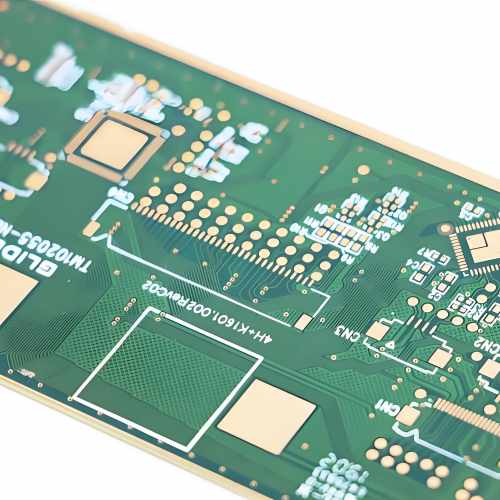
What are the materials for halogen-free PCBs?
What are the materials for halogen-free PCBs?
Common halogen-free materials include TUC's TU883 series, Isola's DE156 series, GreenSpeed series, and Shengyi's S1165/S1165M/S0165 series, among others.
Detailed Introduction:
The core of halogen-free PCBs lies in the use of flame-retardant materials that do not contain halogens (chlorine Cl, bromine Br). Their material systems primarily consist of phosphorus- and nitrogen-based compounds combined with high-performance resin matrices, enhancing the overall performance of the circuit boards while meeting stringent environmental requirements. Below is a detailed classification and characteristic analysis of common halogen-free materials:
I. Copper Clad Laminate (CCL) Substrates: The Core Carrier for Halogen-Free Solutions
CCLs serve as the foundational material for halogen-free PCBs, directly determining the reliability of the circuit boards. Mainstream halogen-free CCLs achieve efficient fire resistance through a phosphorus/nitrogen synergistic flame-retardant mechanism, while optimizing resin systems to enhance heat resistance, insulation, and processing stability.
- TUC TU883 Series
- Characteristics: Utilizes a combination of phosphorus-based flame retardants and high-Tg epoxy resins, with a Tg value exceeding 170°C, meeting the requirements of lead-free soldering processes (peak temperature of 260°C).
- Advantages: Low coefficient of thermal expansion (CTE), reducing interlayer stress; low water absorption (<0.2%), improving moisture resistance; compatibility with high-speed signal transmission (Dk ≈ 3.9, Df ≈ 0.008).
- Applications: High-frequency and high-speed scenarios such as 5G communication equipment and server motherboards.
- Isola DE156 Series
- Characteristics: Features a nitrogen-phosphorus composite flame-retardant system that releases non-flammable gases (e.g., nitrogen) during combustion and forms an expanded char layer, achieving a UL94 V-0 flame rating.
- Advantages: High insulation resistance (>1×10¹² Ω), suitable for high-voltage applications; excellent resistance to conductive anodic filament (CAF) growth, extending product lifespan.
- Applications: High-reliability fields such as automotive power control systems and industrial power modules.
- Shengyi Technology S1165/S1165M/S0165 Series
- Characteristics:
- S1165: Standard Tg (170°C), suitable for multilayer board cores.
- S1165M: Medium Tg (150°C), cost-optimized.
- S0165: High Tg (180°C), meeting extreme heat resistance requirements.
- Advantages: Excellent lead-free compatibility, passing AEC-Q200 automotive-grade certification; low Z-axis CTE (<3%), reducing the risk of interlayer delamination.
- Applications: Consumer electronics (smartphones, tablets) and automotive electronics (ADAS sensors, battery management systems).
- Characteristics:
II. Flame-Retardant Systems: Environmentally Friendly Solutions Through Phosphorus/Nitrogen Synergy
Traditional brominated flame retardants (e.g., PBB, PBDE) generate highly toxic substances such as dioxins during combustion, whereas halogen-free materials achieve environmentally friendly flame retardancy through the following mechanisms:
- Phosphorus-Based Flame Retardants
- Representative Substances: Red phosphorus, phosphate esters (e.g., RDP, BDP).
- Principle: Decomposes during combustion to form metaphosphoric acid, creating a char layer that covers the material surface, isolating oxygen and heat sources.
- Characteristics: High flame-retardant efficiency, but red phosphorus is hygroscopic and requires microencapsulation; phosphate esters exhibit good compatibility with resins but may affect heat resistance.
- Nitrogen-Based Flame Retardants
- Representative Substances: Melamine cyanurate (MCA), ammonium polyphosphate (APP).
- Principle: Releases non-flammable gases (e.g., nitrogen, ammonia) during combustion, diluting oxygen concentration and forming an expanded char layer.
- Characteristics: Low smoke and toxicity, but flame-retardant efficiency is lower when used alone, often compounded with phosphorus-based flame retardants.
- Phosphorus-Nitrogen Composite Flame Retardants
- Representative Substances: Phosphorus-nitrogen intumescent flame retardants (e.g., IFR).
- Principle: Combines the dual effects of a phosphorus-based char layer and a nitrogen-based expanded char layer, significantly improving flame-retardant efficiency.
- Characteristics: Superior overall performance, becoming the mainstream choice for high-end halogen-free materials.
III. Auxiliary Materials: Balancing Functionality and Process Compatibility
- Low-VOC Inks
- Characteristics: Utilize water-based or high-solid resins, reducing VOC emissions by over 80% compared to traditional inks.
- Advantages: Compliance with environmental regulations such as RoHS and REACH; excellent chemical resistance, meeting the requirements of high-density interconnect (HDI) processes.
- Applications: Surface coatings such as solder masks and character markings.
- Nano-Silver Conductive Inks
- Characteristics: Use nano-silver particles as the conductive phase, replacing traditional electroless copper plating processes.
- Advantages: Low-temperature sintering (<200°C), compatible with flexible substrates; line width/spacing down to 10 μm, suitable for high-precision circuits.
- Applications: Flexible electronics, wearable devices, and medical sensors.
IV. Key Considerations for Material Selection
- Environmental Compliance: Must meet international standards (e.g., IPC-4101B, JPCA-ES-01-2003) for halogen content limits (single halogen ≤ 900 ppm, total halogens ≤ 1500 ppm).
- Performance Matching: Select parameters such as Tg value, Dk/Df, and CTE based on application scenarios, e.g., low-loss materials (Df < 0.005) for high-frequency communications.
- Process Compatibility: Halogen-free materials are typically harder and have higher Tg values, requiring optimization of drilling parameters (e.g., reduced drilling speed, increased chip removal frequency) and lamination processes (e.g., segmented pressing, slow heating).
V. Market Trends and Future Directions
With the rapid growth of high-end markets such as 5G and automotive electronics, halogen-free materials are evolving toward high-frequency, high-speed, high-reliability, and cost-effective solutions. For example, the introduction of novel substrates such as liquid crystal polymers (LCP) and hydrocarbon resins will further expand the applications of halogen-free PCBs in AI servers and autonomous driving. The global halogen-free PCB market is expected to surpass $8 billion by 2025, with a compound annual growth rate of 12%.
ShwayPCB, Specialized Production: FP4, High TG, halogen-free, aluminum/copper/ceramic-based, and Rogers material printed circuit boards (PCBs).
Offerings: Double-sided boards, multilayer boards, HDI (High-Density Interconnect) boards, rigid-flex boards, high-frequency boards, etc., to cater to diverse requirements.
Surface Finish Processes: OSP (Organic Solderability Preservative), HASL (Hot Air Solder Leveling), ENIG (Electroless Nickel/Immersion Gold), immersion silver, immersion tin, electroplated nickel-gold, and electroless palladium, etc.
Product Application Areas: Industrial control, telecommunications equipment, consumer electronics, automotive electronics, medical devices, aerospace, computers and data centers, energy and power, IoT (Internet of Things) and smart home, military and defense, marine electronics, AI (Artificial Intelligence) terminals.
Contact us immediately at yuan@shwaypcb.com to obtain preferential quotations.