Ultimate Guide to One-Stop Turnkey PCB Assembly Services: A Comprehensive Analysis from Design to Delivery
Ultimate Guide to One-Stop Turnkey PCB Assembly Services: A Comprehensive Analysis from Design to Delivery
Introduction: Turnkey PCB Assembly – The "Turnkey" Solution for Electronics Manufacturing
In the electronics industry, balancing time, cost, and quality is the core of competition. Traditional PCB projects require coordinating with multiple suppliers for design, manufacturing, component procurement, and assembly, leading to lengthy processes and potential delays or defects due to communication errors. Statistics show that 60% of PCB project delays stem from supply chain coordination issues, while 30% of cost overruns are related to component procurement or rework.
Turnkey PCB assembly services provide a "one-stop" solution by integrating PCB manufacturing, component procurement, SMT/THT assembly, and functional testing, significantly enhancing efficiency and reducing risks. This article delves into the implementation strategies and industry best practices for Turnkey PCB assembly from technical, process, and supplier selection perspectives.
1. Core Processes and Technical Analysis of Turnkey PCB Assembly
Turnkey services cover the entire chain from design files to finished product delivery, with key stages including:
1.1 PCB Design and Manufacturing (PCB Manufacturing)
Design Input: Gerber files, BOM lists, and assembly drawings must comply with IPC-2221/IPC-A-600 standards to ensure manufacturability (DFM).
- Key Parameters:
- Layer count (4-16 layers), board thickness (0.4-3.2mm), copper thickness (1oz-10oz)
- Minimum line width/spacing (3mil/3mil), minimum hole diameter (0.2mm)
- Surface finish (HASL, ENIG, OSP, immersion gold)
Manufacturing Process:
- Inner Layer Fabrication: Chemical etching generates circuit patterns, followed by AOI inspection for shorts/opens.
- Lamination: High-temperature and high-pressure bonding of inner layers with prepreg, with X-Ray inspection for layer alignment.
- Drilling: CNC drilling for through-holes with a tolerance of ±0.05mm; laser drilling for microvias (<0.15mm).
- Outer Layer Processing: Copper deposition, plating, imaging, etching, and solder mask printing (LPI or photosensitive ink).
Case Study: A 12-layer HDI board for a 5G base station utilized blind/buried vias + laser microvias to achieve high-density interconnects. The Turnkey supplier coordinated manufacturing and assembly processes to ensure signal integrity (SI) compliance.
1.2 Component Procurement and Inventory Management
A key advantage of the Turnkey model is centralized component procurement, requiring suppliers to possess:
- Global Supply Chain Network: Covering original manufacturers (e.g., TI, ADI), authorized distributors (e.g., Digi-Key, Arrow), and independent distributors (for long-lead-time or obsolete parts).
- BOM Optimization Capabilities:
- Alternative Component Recommendations: Providing compliant alternatives based on cost, lead time, and performance match (subject to customer approval).
- Multi-Sourcing: Procuring critical components (e.g., MCUs, FPGAs) from 2-3 suppliers to mitigate supply disruption risks.
- Inventory Strategies:
- VMI (Vendor-Managed Inventory): Maintaining safety stock for common components (e.g., 0402 resistors, 0603 capacitors) to shorten Quick Turn cycles.
- JIT (Just-in-Time): Procuring high-value components (e.g., BGAs, QFNs) in batches aligned with production schedules to reduce capital tie-up.
Data: A consumer electronics project reduced component types from 1,200 to 900 through Turnkey supplier BOM optimization, cutting procurement costs by 18% and lead times by 25%.
1.3 PCB Assembly (PCB Assembly)
Assembly includes SMT (Surface Mount Technology), THT (Through-Hole Technology), and hybrid assembly, with technical highlights as follows:
SMT Process
- Printing: Stencil thickness (0.1-0.15mm) and aperture design must match component pin pitches, with printing accuracy of ±0.05mm.
- Pick-and-Place: High-speed pick-and-place machines (e.g., Siemens HS60) achieve 0201/01005 component placement with ±0.03mm accuracy.
- Reflow Soldering:
- Temperature profiles consist of preheat, soak, reflow, and cooling stages, with peak temperatures below component maximum ratings (e.g., 245±5℃ for BGAs).
- Nitrogen atmosphere (O2 concentration <50ppm) reduces oxidation and enhances solder reliability.
THT Process
- Wave Soldering: Suitable for axial/radial components, with precise control of flux spray, preheat, and wave height (typically 1.5-2.5mm).
- Selective Wave Soldering: Localized soldering for high-density THT components (e.g., connectors) to avoid bridging defects.
Post-Assembly Inspection
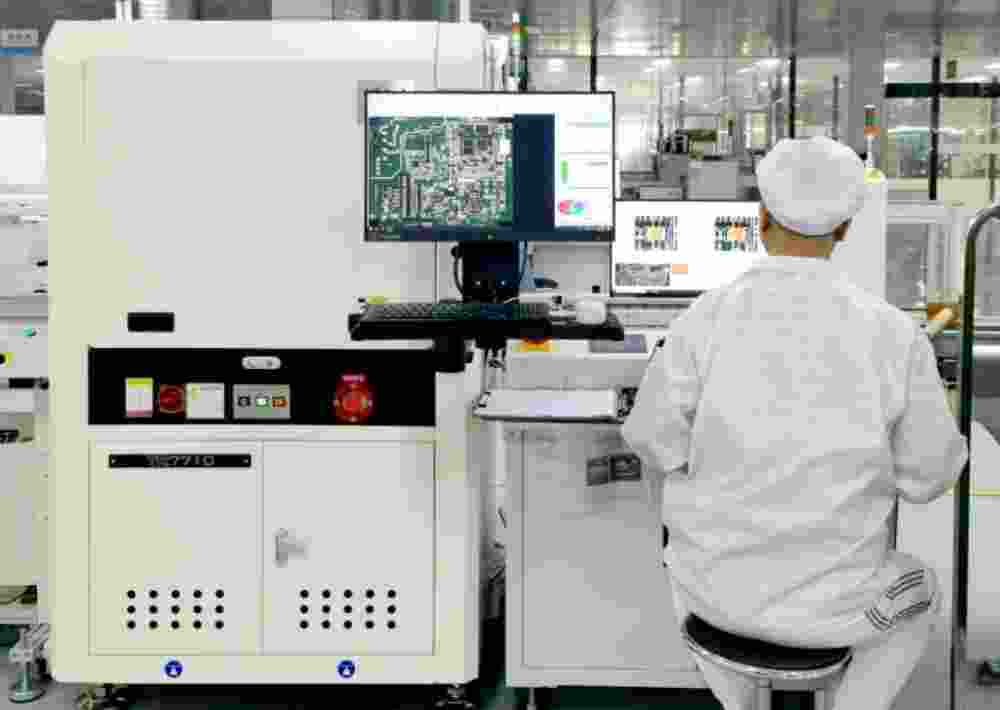
- AOI (Automated Optical Inspection): Detects component misalignment, polarity errors, and solder defects (e.g., cold solder, bridging).
- AXI (X-Ray Inspection): Inspects internal solder joints of BGAs, CSPs, and other bottom-terminated components, with void rate targets typically <30%.
- Functional Testing (FCT): Validates circuit functionality (e.g., voltage, current, signal timing) using test fixtures under simulated operating conditions.
1.4 Quick Turn PCB Assembly: Accelerating Time-to-Market
Quick Turn services shorten lead times through concurrent engineering and flexible manufacturing, with a typical process:
- Pre-Design Freeze: Suppliers participate in DFM reviews to identify manufacturability risks (e.g., insufficient component spacing, undersized holes).
- Prototyping Phase:
- Rapid Board Fabrication: Laser direct imaging (LDI) replaces traditional exposure, reducing inner layer fabrication time by 24 hours.
- Priority Component Procurement: Sourcing off-the-shelf components (e.g., from local distributors) to compress BOM procurement cycles from 4 weeks to 1 week.
- Low-Volume Verification: Rapid SMT line changeovers (e.g., <1 hour for different products) enable 48-hour delivery of 50-100pcs prototypes.
Case Study: A medical device manufacturer reduced ECG monitor prototype development from 12 weeks to 6 weeks using Turnkey supplier Quick Turn services, securing FDA approval ahead of competitors.
2. Competitive Advantages and Supplier Selection for PCB Assembly in China
China accounts for over 60% of global PCB production capacity, with Turnkey services offering the following strengths:
2.1 Cost Efficiency
- Labor Costs: Chinese SMT operator hourly wages are approximately 1/5 of those in the U.S., directly reducing assembly costs.
- Economies of Scale: The Yangtze River Delta and Pearl River Delta host numerous PCB factories, component distributors, and assembly lines, minimizing logistics and communication expenses.
2.2 Technical Capabilities
- Advanced Manufacturing: Chinese firms have mastered HDI, flexible, and rigid-flex board technologies, meeting 5G, automotive electronics, and other high-requirement applications.
- Automation Levels: Leading companies (e.g., Huawei, Foxconn) achieve SMT line automation rates exceeding 90%, supporting 01005 component placement and 0.3mm pitch BGA soldering.
2.3 Supplier Selection Criteria
Evaluate Turnkey suppliers across the following dimensions:
| Evaluation Dimension | Key Indicators |
|---|---|
| Certifications | ISO 9001 (Quality), IATF 16949 (Automotive), ISO 13485 (Medical), IPC-6012 (PCB Manufacturing) |
| Equipment Capabilities | SMT machine models (e.g., Yamaha YS Series, Panasonic NPM Series), reflow oven temperature uniformity (±2℃ or better) |
| Supply Chain Depth | Proportion of components sourced from original/authorized distributors, capability to resolve long-lead-time component (e.g., custom sensors) issues |
| Track Record | Number of high-complexity projects served (e.g., military, aerospace, medical) and customer feedback |
| IT Systems | Support for ERP/MES systems to track order status, manage BOM changes, and trace quality data in real-time |
3. Challenges and Mitigation Strategies in Turnkey PCB Assembly
3.1 Supply Chain Risks
- Challenge: Global chip shortages and geopolitical conflicts may disrupt critical component supply.
- Mitigation:
- Multi-Sourcing: Sign long-term agreements (LTAs) with 2-3 suppliers to diversify risks.
- Localization: Prioritize domestic components (e.g., Changjiang Electronics' BGA packages) to reduce import dependency.
3.2 Quality Consistency
- Challenge: Tolerance accumulation across PCB batches or components may cause assembly defects (e.g., BGA misalignment).
- Mitigation:
- Statistical Process Control (SPC): Monitor critical parameters (e.g., reflow temperature, pick-and-place pressure) with CPK values ≥1.33.
- First Article Inspection (FAI): Verify the first product of each batch against IPC-A-610 Class 2/3 standards.
3.3 Intellectual Property Protection
- Challenge: Risk of design file leakage or component counterfeiting.
- Mitigation:
- NDA Agreements: Sign confidentiality agreements with suppliers, specifying penalty clauses for breaches.
- Component Traceability: Require suppliers to provide original manufacturer Certificates of Conformance (COC) and RoHS reports.
4. Future Trends: Intelligence and Sustainability in Turnkey Services
4.1 Industry 4.0 Integration
- Digital Twins: Optimize PCB layouts and assembly processes through virtual simulations, reducing prototype iterations.
- AI-Driven Solutions: Use machine learning to predict component lifespans (e.g., ESR changes in electrolytic capacitors) and schedule proactive maintenance or replacements.
4.2 Green Manufacturing
- Lead-Free Processes: Comply with RoHS/REACH regulations using lead-free solders (Sn-Ag-Cu alloys).
- Energy Management: Adopt energy-efficient reflow ovens (e.g., heat pump technology) to reduce carbon emissions by over 30%.
Conclusion: Turnkey PCB Assembly – The Efficiency Revolution in Electronics Manufacturing
One-stop Turnkey PCB assembly services integrate design, manufacturing, procurement, assembly, and testing, providing efficient solutions for high-complexity, rapid-iteration projects. Leveraging cost, technical, and supply chain advantages, China has emerged as the global hub for Turnkey services. Selecting suppliers with certifications, equipment capabilities, and supply chain depth, while implementing stringent quality control and risk management, maximizes the value of Turnkey models.
Contact Email: yuan@shwaypcb.com
Website: https://fr4pcb.tech/