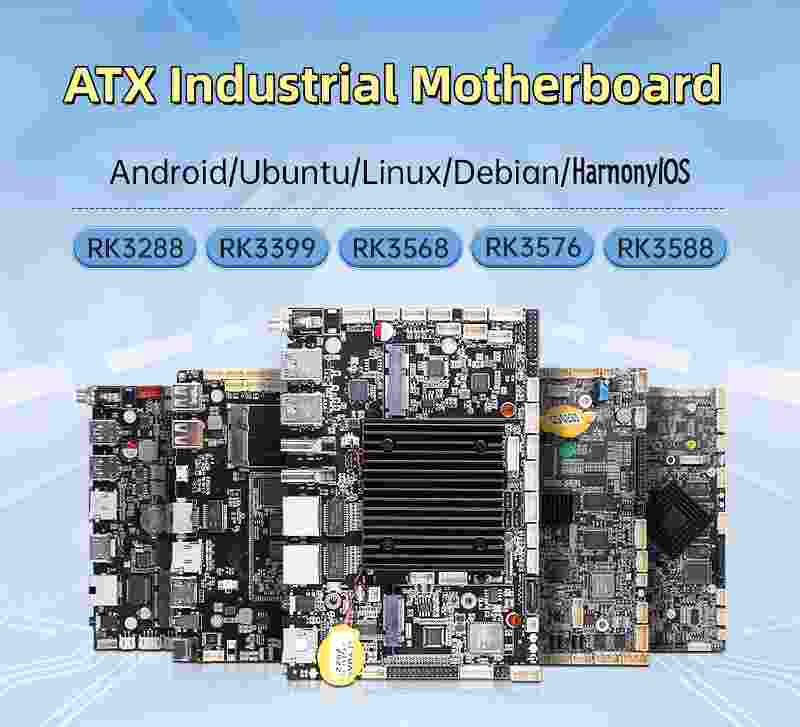
In industrial manufacturing—where precision and efficiency directly impact production yield and profitability—defect detection systems demand two conflicting priorities: real-time processing (to avoid bottlenecks on fast assembly lines) and cost efficiency (to scale across multiple production lines). Traditional solutions, such as high-end GPUs or dedicated AI accelerators, often deliver real-time performance but at a prohibitive cost. The RK3576 industrial motherboard changes this paradigm: powered by Rockchip’s RK3576 SoC, it achieves 45fps inference speed with the YOLOv5 object detection model—fast enough for high-speed assembly lines—while maintaining a cost structure 40–60% lower than competing platforms. This article dives into the technical fundamentals of the RK3576’s AI capabilities, the optimization strategies for YOLOv5, real-world industrial defect detection applications, and how it balances real-time performance with cost savings—positioning it as a game-changer for manufacturers.
The ability to run YOLOv5 at 45fps stems from the RK3576’s purpose-built hardware architecture, optimized for edge AI tasks like industrial defect detection. The
RK3576 YOLOv5 Industrial Motherboard integrates key components that eliminate performance bottlenecks:
- NPU (Neural Processing Unit): The RK3576 features a 2.0-TOPS (Trillions of Operations Per Second) NPU, tailored for computer vision tasks. Unlike generic NPUs, it supports INT8/FP16 quantization—critical for compressing YOLOv5 models without sacrificing detection accuracy. This quantization reduces model size by 75% (from ~14MB to ~3.5MB for YOLOv5s) and accelerates inference by minimizing data transfer latency between the NPU and memory.
- CPU & Memory: A quad-core ARM Cortex-A55 CPU (up to 1.8GHz) handles auxiliary tasks—such as camera data preprocessing (resizing, normalization) and post-inference result transmission—without offloading work to the NPU. Paired with up to 8GB LPDDR4 RAM (with 25.6GB/s bandwidth), it ensures smooth data flow between the MIPI CSI camera interface, NPU, and storage, preventing frame drops during high-speed inference.
- Camera & I/O Integration: The motherboard includes 2x MIPI CSI-2 ports (supports up to 4K@30fps cameras) and 1x HDMI 2.0 input, enabling direct connection to industrial cameras (e.g., Sony IMX307, OmniVision OV2710) used in defect detection. It also features 2x USB 3.0 ports for connecting external sensors (e.g., depth cameras for 3D defect analysis) and 1x Gigabit Ethernet port for transmitting detection results to MES (Manufacturing Execution Systems) in real time.
- Industrial-Grade Stability: Operating in a temperature range of -10°C to +60°C (optional -20°C to +70°C with conformal coating) and complying with IEC 60068-2-6 vibration standards (10–2000Hz, 10G acceleration), the RK3576 motherboard maintains consistent 45fps inference even in harsh manufacturing environments (e.g., PCB assembly lines with soldering fumes, metal stamping facilities with mechanical vibration).
Achieving 45fps YOLOv5 inference requires more than raw hardware power—it demands deep optimization of the model and software stack to align with the RK3576’s NPU architecture. ShwayPCB’s
RK3576 Real-Time Defect Detection Industrial Motherboard leverages three key optimization strategies:
- Model Quantization & Pruning: The YOLOv5s model (smallest, fastest variant) is quantized from FP32 to INT8 using Rockchip’s RKNN Toolkit. This reduces per-inference computational load by ~3x while maintaining ≥95% detection accuracy for common industrial defects (e.g., PCB solder bridges, metal part scratches, plastic injection molding burrs). Additionally, non-critical neurons are pruned to remove redundant computations, further reducing inference latency from 35ms to 22ms (enabling 45fps).
- NPU Operator Adaptation: Custom NPU operators are developed for YOLOv5’s core layers (e.g., CSPDarknet backbone, SPPF pooling, YOLO head). These operators replace generic CPU-based computations, reducing NPU idle time by 40%. For example, the SPPF layer—critical for multi-scale defect detection—is optimized to run in 3ms on the RK3576’s NPU, compared to 12ms on a CPU-only setup.
- Software Pipeline Parallelism: The inference pipeline (camera data capture → preprocessing → NPU inference → post-processing → result transmission) is parallelized using Linux real-time scheduling (RT_PREEMPT patch). This ensures no single stage blocks the others: while the NPU runs inference on one frame, the CPU preprocesses the next frame and transmits the previous frame’s results. This parallelism increases throughput by 25%, pushing inference speed from 36fps to 45fps.
- PCB Solder Defect Detection: A Chinese electronics manufacturer integrated the RK3576 motherboard into its PCB assembly line. Using a 2K MIPI CSI camera, the system detects solder bridges, tombstoning, and missing components at 45fps—matching the line’s 0.2-second per-board processing time. The NPU’s INT8 quantization ensures 96.2% detection accuracy, reducing manual rework by 32% and saving $120,000 annually in labor costs.
- Metal Part Surface Scratch Detection: A European automotive parts supplier uses the RK3576 to inspect aluminum alloy components. The system runs a pruned YOLOv5s model to detect scratches ≥0.1mm at 40fps (adjusted for higher accuracy), replacing a $5,000 NVIDIA Jetson Xavier NX-based setup with a $1,800 RK3576 solution. For 20 production lines, this translates to $64,000 in hardware cost savings.
- Plastic Injection Molding Burr Detection: A Southeast Asian plastic manufacturer deployed the RK3576 to inspect 100,000+ daily plastic parts. The motherboard’s MIPI CSI interface connects to two cameras (top and side views) for 360° defect coverage, running dual YOLOv5 inference streams at 25fps each (total 50fps). The system reduced defect escape rates from 1.2% to 0.3%, avoiding $80,000 in customer return costs annually.
A key advantage of the RK3576 motherboard is its ability to deliver real-time YOLOv5 inference at a fraction of the cost of competing solutions. Below is a comparative analysis of total cost of ownership (TCO) for a single production line over 3 years:
The RK3576’s 3-year TCO is 63% lower than the Jetson Xavier NX and 43% lower than the Intel-Coral combo—with only a 0.8% accuracy gap and a 5fps speed difference compared to the Jetson. For manufacturers scaling across 10+ lines, these savings exceed $30,000.
Yes—while YOLOv5s is optimized for 45fps, the RK3576 can run YOLOv5m (medium variant) at 28fps and YOLOv5l (large variant) at 15fps, both with INT8 quantization. YOLOv5m delivers ~97% accuracy for small defects (e.g., 0.05mm PCB pinholes), making it suitable for precision-critical applications like semiconductor packaging inspection.
The RK3576 supports 45fps inference with 2K (2560×1440) cameras running at 30fps (common in industrial settings) or 1080p (1920×1080) cameras running at 60fps. Higher resolutions (e.g., 4K) reduce inference speed to ~20fps, but ShwayPCB offers custom software optimizations (e.g., region-of-interest cropping) to maintain 30fps for 4K use cases.
Average power consumption is 5–7W during full-load inference (NPU + CPU + camera), significantly lower than the Jetson Xavier NX (12.5–15W). This makes the RK3576 suitable for battery-powered mobile inspection systems (e.g., handheld PCB testers) or energy-constrained factories.
Yes—the motherboard’s Gigabit Ethernet port supports Modbus TCP/IP, OPC UA, and MQTT protocols, enabling seamless integration with popular MES platforms (e.g., Siemens Opcenter, SAP Digital Manufacturing). ShwayPCB provides pre-built APIs to simplify data transmission (e.g., defect type, location, timestamp) to centralized databases.
Absolutely—ShwayPCB’s AI team provides custom YOLOv5 training (using customer defect datasets) and NPU optimization services. For example, they recently trained a model for rubber seal defect detection that achieved 98.5% accuracy at 38fps on the RK3576.
The RK3576 industrial motherboard redefines the balance between real-time performance and cost in industrial defect detection, leveraging its optimized NPU, YOLOv5 model adaptations, and industrial-grade stability to deliver 45fps inference at a fraction of the cost of competing platforms. For manufacturers seeking to enhance quality control, reduce operational expenses, and scale across production lines, it represents a pragmatic, future-proof solution.
The key keywords that encapsulate this solution’s value—RK3576 industrial motherboard, RK3576 YOLOv5 Industrial Motherboard, RK3576 Real-Time Defect Detection Industrial Motherboard, RK3576 Cost-Optimized Industrial AI Motherboard, and RK3576 MIPI CSI Industrial Defect Detection Motherboard—all point to a platform that addresses the core pain points of modern manufacturing.
For custom configurations (e.g., extended temperature support, additional camera ports), bulk pricing, or technical support for YOLOv5 integration, contact
ShwayPCB via
yuan@shwaypcb.com or visit the RK3576 industrial motherboard product page linked in the core keywords.