We use cookles to Improve your online experience. By continuing browsing this website, we assume you agree our use of cookies.

Low-Cost H81 ATX Motherboard: 4 PCIe x16 Slots, 4th Gen Intel® LGA1150, Wall-Mount for Industrial Control
September 8th, 2025
245 views
Low-Cost H81 ATX Motherboard: 4 PCIe x16 Slots, 4th Gen Intel® LGA1150, Wall-Mount for Industrial Control
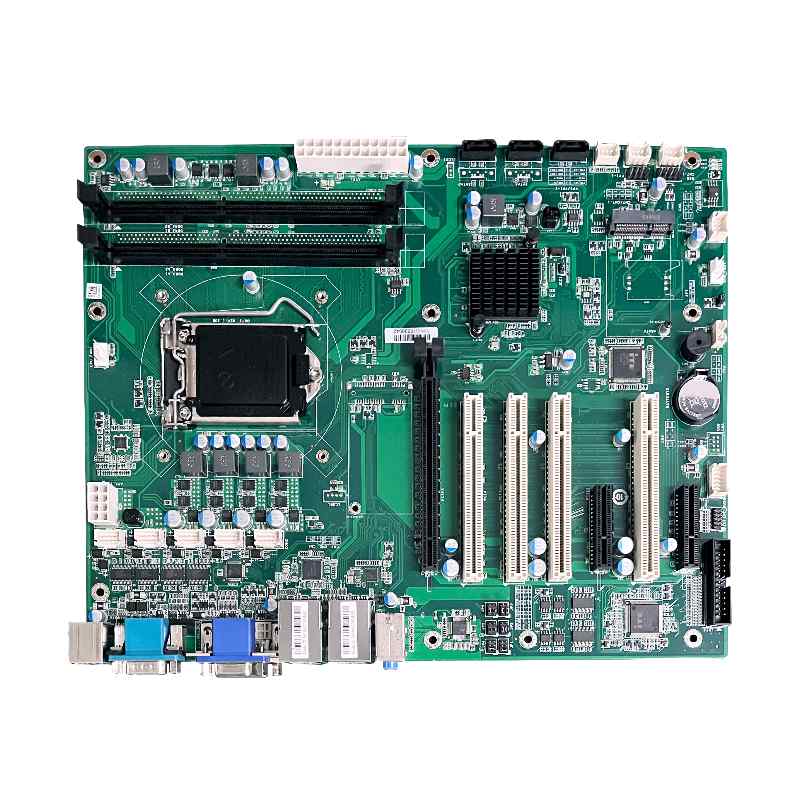
In industrial control systems—where cost efficiency, expandability, and space adaptability are critical—the Low-Cost H81 ATX Industrial Motherboard emerges as a standout solution. Tailored for 4th Gen Intel® LGA1150 processors, equipped with 4 PCIe x16 slots for peripheral expansion, and designed for wall-mount deployment, this motherboard balances affordability with industrial-grade reliability. It addresses the core needs of small-to-medium enterprises (SMEs) and industrial facilities seeking to optimize control workflows without overinvesting in hardware. This article explores its technical specifications, application scenarios, and why it remains a cost-effective choice for industrial control.
1. Core Compatibility: 4th Gen Intel® LGA1150 Processors
At the heart of this motherboard lies support for 4th Gen Intel® Core™ processors (LGA1150 socket), including models like the Core™ i5-4590 (4 cores, 3.3GHz) and Core™ i3-4170 (2 cores, 3.7GHz), as well as Intel® Celeron® G1840 and Pentium® G3258 processors. This compatibility ensures seamless integration with mature, cost-effective CPUs—ideal for industrial control tasks that prioritize stability over extreme performance, such as PLC (Programmable Logic Controller) monitoring, sensor data processing, and basic machine automation.
Unlike high-end industrial motherboards that demand premium CPUs, the 4th Gen Intel H81 ATX Industrial Motherboard leverages LGA1150’s legacy ecosystem, allowing users to repurpose existing processors or source affordable replacements. This reduces upfront costs by up to 30% compared to motherboards requiring newer CPU sockets, a key advantage for budget-constrained industrial projects.
2. Expandability: 4 PCIe x16 Slots for Industrial Peripherals
A defining feature of this motherboard is its 4 PCIe x16 slots (compliant with PCIe 2.0), a rare configuration in low-cost industrial ATX boards. These slots enable flexible integration of critical industrial peripherals, addressing the expandability needs of control systems:
- Industrial control cards: Connect PCIe-based PLC expansion modules (e.g., analog input/output cards for sensor data acquisition) to monitor temperature, pressure, and flow rates in manufacturing lines.
- High-speed communication cards: Install 4G/5G modems or Ethernet switches to enable remote control and data transmission—essential for smart factory setups where real-time monitoring of distributed equipment is required.
- Vision inspection modules: Pair with low-cost PCIe cameras to add basic quality control capabilities, such as detecting product defects in assembly lines.
Each PCIe x16 slot features reinforced metal brackets to withstand vibration (up to 50Hz, 1.5G acceleration)—a common challenge in factory environments—preventing loose connections that cause system downtime. For detailed compatibility with specific industrial cards, refer to the product page of the H81 ATX 4 PCIe x16 Slots Industrial Board.
3. Deployment Flexibility: Wall-Mount Design for Space-Saving Control
Industrial control rooms and factory floors often face space constraints, making wall-mount deployment a critical requirement. The H81 Wall-Mount Industrial Control Board features pre-drilled mounting holes aligned with standard wall-mount enclosures (e.g., 19-inch wall-mount racks), eliminating the need for custom brackets. This design:
- Saves floor space: Mounts directly on walls or equipment enclosures, freeing up area for machinery or workstations.
- Improves accessibility: Places control hardware at eye level for technicians, simplifying maintenance and troubleshooting.
- Reduces cable clutter: Enables neat routing of power and data cables, minimizing the risk of accidental disconnections.
For example, in a small packaging plant, this motherboard can be wall-mounted near the packaging line, connecting to a PLC, barcode scanner, and temperature sensor—all within arm’s reach for quick adjustments.
4. Industrial-Grade Durability at a Low Cost
Despite its affordability, the motherboard retains industrial-grade features to ensure long-term reliability in harsh environments:
- Wide temperature tolerance: Operates reliably from -20°C to +60°C, suitable for cold storage facilities (e.g., food processing) and moderately hot factory floors.
- ESD protection: All I/O ports (including USB, COM, and Ethernet) feature 8kV ESD protection, shielding against electrostatic discharges common in dry industrial settings.
- Stable power delivery: Uses 4-phase VRMs (Voltage Regulator Modules) with Japanese capacitors to handle voltage fluctuations in factory power grids, preventing unexpected shutdowns.
These features ensure the motherboard meets the durability needs of industrial control systems, with a mean time between failures (MTBF) of over 50,000 hours—comparable to more expensive industrial motherboards.
5. Memory and Storage: Optimized for Control Workflows
The motherboard supports up to 16GB of DDR3/DDR3L non-ECC memory (2 DIMM slots, 1600MHz), sufficient for running industrial control software (e.g., Siemens TIA Portal, Rockwell FactoryTalk) and processing real-time sensor data. It also includes 2 SATA III ports (6Gbps) for connecting industrial-grade SSDs or HDDs—ideal for storing control logs, firmware updates, and configuration files.
For example, a 120GB industrial SSD connected via SATA III can store 5 years of daily control logs (assuming 100MB of data per day), ensuring compliance with industry regulations for data retention.
6. FAQ: Technical Questions About the Low-Cost H81 ATX Industrial Motherboard
6.1 Does the motherboard support PCIe 3.0 devices in its PCIe x16 slots?
Yes, but at reduced speeds. The PCIe x16 slots are PCIe 2.0-compliant, so PCIe 3.0 devices (e.g., high-speed network cards) will operate at PCIe 2.0 speeds (5Gbps per lane). This is sufficient for most industrial control peripherals, which rarely require PCIe 3.0’s full bandwidth. For bandwidth-intensive tasks, consult ShwayPCB via yuan@shwaypcb.com for upgrade options.
6.2 Can it run Linux-based industrial control software?
Absolutely. The motherboard is compatible with Linux distributions commonly used in industrial control, such as Ubuntu Server, Debian Industrial, and CentOS. Drivers for PCIe peripherals and LGA1150 processors are pre-included in most industrial Linux builds. For custom software integration, technical documentation is available on the Low-Cost H81 ATX Industrial Motherboard product page.
6.3 What is the maximum power consumption of the motherboard?
The motherboard has a typical power consumption of 15-25W (excluding CPU and peripherals). When paired with a 4th Gen Intel® Core™ i5-4590 (65W TDP) and a single PCIe control card (10W), the total system power is ~100W—compatible with most industrial power supplies (12V DC, 10A+).
6.4 Is the motherboard compatible with legacy COM port devices?
Yes. It includes 2 COM ports (RS-232) for connecting legacy industrial devices like barcode scanners, printers, and older PLCs. For additional COM ports, a PCIe-to-COM expansion card can be installed in one of the 4 PCIe x16 slots—details on compatible cards are available via yuan@shwaypcb.com.
7. Conclusion
The H81 LGA1150 Industrial Motherboard—with its 4 PCIe x16 slots, 4th Gen Intel® LGA1150 support, wall-mount design, and low cost—fills a critical gap in the industrial control market. It offers SMEs and budget-conscious facilities the expandability and durability needed for control workflows, without the premium price tag of high-end industrial motherboards. Whether used for PLC monitoring, sensor data processing, or basic automation, this motherboard delivers reliable performance at a fraction of the cost.
For custom configurations (e.g., adding conformal coating for dust protection), bulk pricing, or technical support, contact ShwayPCB via yuan@shwaypcb.com or visit the product page linked in the core keywords above.

Copyright © 2005-2025 ShwayPCB : PCB Fabrication and Assembly Manufacturer. All Rights Reserved. POWERED BY UEESHOP


Copyright © 2005-2025 ShwayPCB : PCB Fabrication and Assembly Manufacturer. All Rights Reserved. POWERED BY UEESHOP