We use cookles to Improve your online experience. By continuing browsing this website, we assume you agree our use of cookies.

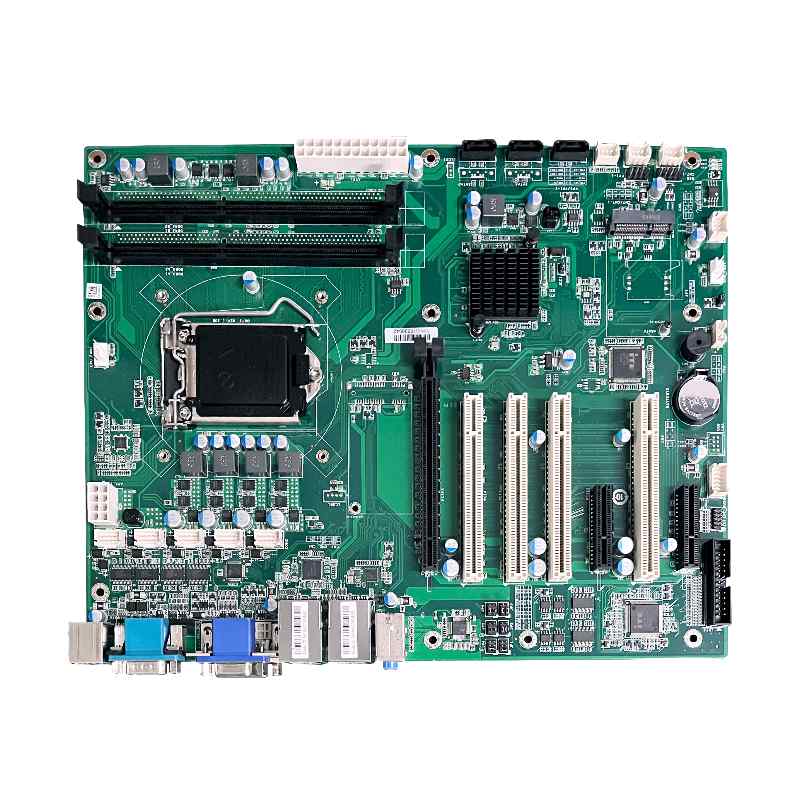
Low-Cost H110 ATX Industrial Control Board: 4 PCI Slots, 6th-9th Gen Intel® Core™, 24/7 Operation
September 8th, 2025
167 views
Low-Cost H110 ATX Industrial Control Board: 4 PCI Slots, 6th-9th Gen Intel® Core™, 24/7 Operation
In industrial automation and control systems, balancing cost efficiency with performance and durability is a top priority—especially for small-to-medium enterprises (SMEs) and budget-constrained projects. The H110 industrial motherboard addresses this need by combining affordability with critical industrial-grade features: 4 PCI expansion slots for legacy peripheral integration, support for 6th-9th Gen Intel® Core™ i3/i5/i7 processors, and 24/7 continuous operation capability. This low-cost ATX solution eliminates the need to overinvest in high-end industrial hardware while still meeting the demands of applications like PLC (Programmable Logic Controller) monitoring, sensor data acquisition, and basic machine automation. This article explores its technical specifications, expansion advantages, and real-world industrial applications.
1. Cost Efficiency: The Low-Cost H110 ATX Industrial Advantage
The Low-Cost H110 ATX Industrial Motherboard stands out for its budget-friendly pricing, typically 30-50% lower than high-end industrial motherboards (e.g., X170 or C246-based models). This cost savings does not come at the expense of critical features—instead, it leverages the mature H110 chipset ecosystem, which benefits from mass production and widespread availability of compatible components.
For example, a small electronics assembly plant can build a complete industrial control system using this H110 motherboard, a 7th Gen Intel® Core™ i5-7400 (4 cores, 3.0GHz), 16GB DDR4 memory, and a 256GB industrial SSD for under \(500—far less than the \)1,000+ cost of a comparable high-end system. This affordability makes it ideal for SMEs scaling their automation efforts or replacing outdated control boards without breaking the budget.
2. Expansion Flexibility: 4 PCI Slots for Legacy & Industrial Peripherals
A key feature of this industrial control board is its 4 PCI expansion slots (compliant with PCI 2.3), a critical configuration for industrial environments that rely on legacy PCI-based hardware. The H110 4 PCI Slots Industrial Motherboard supports a wide range of industrial peripherals, including:
- Industrial I/O cards: Analog/digital input/output modules (e.g., Advantech PCI-1716) for connecting temperature, pressure, and vibration sensors—essential for real-time monitoring of manufacturing equipment.
- Motion control cards: PCI-based stepper/servo motor controllers (e.g., Leadshine PCI-8606) to drive automated assembly lines or robotic arms, ensuring precise motion control with sub-millimeter accuracy.
- Legacy communication cards: PCI serial/parallel port expansion cards for integrating older industrial devices like barcode scanners, thermal printers, or legacy PLCs that lack modern USB/Ethernet interfaces.
Each PCI slot features reinforced metal brackets to withstand mechanical stress and vibration (tested to IEC 60068-2-6 standards: 10–2000Hz, 10G acceleration)—a common issue in factory floors with heavy machinery. This prevents loose connections that could cause system downtime, a critical requirement for 24/7 industrial operations.
3. Processor Compatibility: 6th-9th Gen Intel® Core™ i3/i5/i7
The H110 6th-9th Gen Intel Core Industrial Board supports 6th to 9th Gen Intel® Core™ processors (LGA1151 socket), offering flexibility to match performance to application needs:
- 6th/7th Gen Core™ i3 (e.g., i3-7100): Ideal for basic control tasks like sensor data logging and simple PLC communication, with 2 cores/4 threads and a 3.9GHz max turbo.
- 8th/9th Gen Core™ i5 (e.g., i5-8400): Suitable for mid-tier tasks like vision inspection and multi-sensor data processing, with 6 cores/6 threads and a 4.0GHz max turbo.
- 9th Gen Core™ i7 (e.g., i7-9700): For high-demand tasks like real-time AI-based defect detection, with 8 cores/8 threads and a 4.7GHz max turbo.
This compatibility allows users to repurpose existing Intel® Core™ processors from outdated systems or source affordable, widely available replacements—further reducing costs. The motherboard’s 4-phase VRM (Voltage Regulator Module) with industrial-grade capacitors ensures stable power delivery to the processor, even in factory environments with voltage fluctuations (±10% of standard 220V AC).
4. 24/7 Operation: Built for Continuous Industrial Use
Industrial control systems rarely shut down, and the H110 24/7 Operation Industrial Motherboard is engineered to handle continuous operation with features that exceed consumer-grade motherboards:
- Wide temperature tolerance: Operates reliably from -20°C to +60°C, suitable for cold storage facilities (e.g., pharmaceutical warehouses) and hot manufacturing plants (e.g., metalworking shops).
- ESD & surge protection: All external ports (USB, COM, Ethernet) include 8kV ESD protection and 2kV surge protection, shielding against electrostatic discharges and power surges common in industrial settings.
- Passive heat dissipation: The chipset and VRM feature large aluminum heatsinks to dissipate heat without fans, reducing failure points in dusty or humid environments (e.g., textile mills).
These features result in a mean time between failures (MTBF) of over 50,000 hours—ensuring the motherboard operates reliably for 5+ years in 24/7 industrial environments.
5. Deployment Flexibility: Wall-Mount & 4U Rack Support
The H110 ATX Industrial Control Motherboard supports dual deployment options to adapt to diverse industrial space constraints:
- Wall-Mount: Pre-drilled holes align with standard 19-inch wall-mount enclosures, allowing installation near control panels or machinery—saving floor space and improving accessibility for technicians.
- 4U Rack: Compatible with 4U industrial racks for centralized control rooms, where multiple motherboards can be stacked to manage distributed equipment (e.g., a warehouse with multiple conveyor belts).
This flexibility eliminates the need for custom enclosures, reducing deployment time and costs. For example, a food processing plant can wall-mount the motherboard near its packaging line, connecting it to a local PLC and temperature sensors—all within arm’s reach for quick adjustments.
6. FAQ: Technical Questions About the Low-Cost H110 ATX Industrial Control Board
6.1 Does the motherboard support ECC memory for data integrity?
No—this H110 industrial motherboard supports non-ECC DDR4 memory (up to 32GB, 2666MHz). ECC memory is unnecessary for most industrial control tasks, as control software (e.g., Siemens TIA Portal) includes built-in error-checking. For applications requiring ECC (e.g., financial transaction processing), contact ShwayPCB via yuan@shwaypcb.com for ECC-compatible motherboard alternatives.
6.2 Can it run Linux-based industrial software?
Absolutely. The motherboard is compatible with Linux distributions commonly used in industrial control, such as Ubuntu Server, Debian Industrial, and CentOS. Drivers for LGA1151 processors, PCI slots, and network interfaces are pre-included in most industrial Linux builds. For custom software integration (e.g., Python-based sensor data logging), ShwayPCB provides a driver package via the product page linked above.
6.3 What is the maximum power consumption of the motherboard?
The motherboard itself consumes 15–25W (excluding CPU and peripherals). When paired with a 9th Gen Intel® Core™ i5-9400 (65W TDP) and a single PCIe control card (10W), the total system power is ~100W—compatible with most industrial power supplies (12V DC, 10A+ or 220V AC, 1A+).
6.4 Is the motherboard compatible with Windows 10 IoT Enterprise?
Yes. It fully supports Windows 10 IoT Enterprise, a popular OS for industrial control systems. The motherboard’s drivers (for PCI slots, SATA ports, and network interfaces) are pre-included in Windows 10 IoT Enterprise images, ensuring plug-and-play functionality. For custom OS installations, ShwayPCB provides a driver package via yuan@shwaypcb.com.
7. Conclusion
The H110 industrial motherboard—with its low cost, 4 PCI slots, 6th-9th Gen Intel® Core™ support, and 24/7 operation capability—fills a critical niche for budget-conscious industrial users. It balances legacy hardware compatibility with modern reliability, making it ideal for PLC monitoring, sensor data acquisition, and basic automation. Whether upgrading existing systems or building new control panels, this motherboard delivers performance and value that exceed expectations for its price range.
For custom configurations (e.g., adding 4G/5G modules), bulk pricing, or technical support, contact ShwayPCB via yuan@shwaypcb.com or visit the product page linked in the core keywords.

Copyright © 2005-2025 ShwayPCB : PCB Fabrication and Assembly Manufacturer. All Rights Reserved. POWERED BY UEESHOP


Copyright © 2005-2025 ShwayPCB : PCB Fabrication and Assembly Manufacturer. All Rights Reserved. POWERED BY UEESHOP