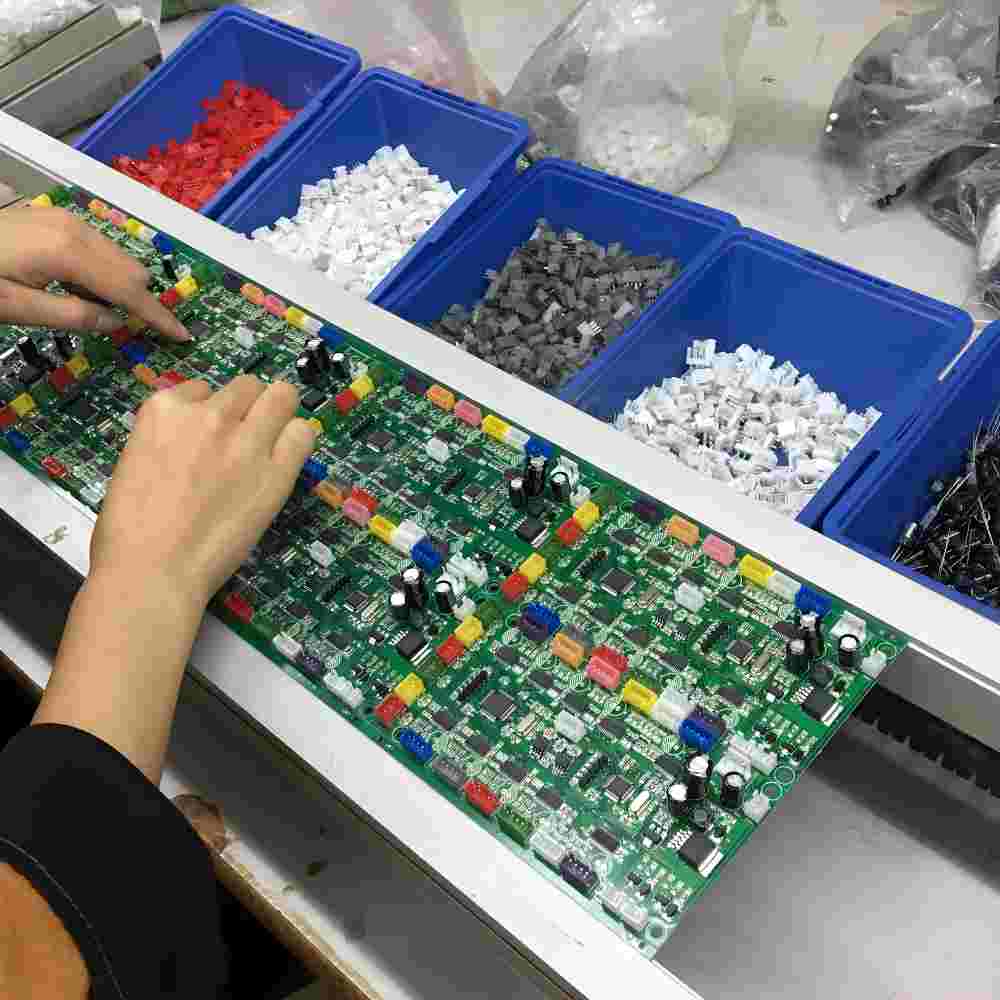
Lead-Free Quick Turn PCB Assembly: 48-Hour Turnaround from China's Top SMT Factory
Lead-Free Quick Turn PCB Assembly: 48-Hour Turnaround from China's Top SMT Factory
——ShwayPCB as a Benchmark: Technical Analysis and Industry Insights
Introduction: The Efficiency Revolution in Global Electronics Manufacturing
In high-tech sectors such as 5G communications, Industrial Internet of Things (IIoT), and new energy vehicles, the lead time for printed circuit board (PCB) delivery has become a critical factor determining product time-to-market. As the global hub for PCB manufacturing, Shenzhen, China, is reshaping industry norms through technological iteration and process optimization. Among them, ShwayPCB stands out with its "48-hour lead-free quick-turn PCB assembly service," setting a benchmark in high-end electronics manufacturing. This article provides an in-depth analysis of the technical foundations and commercial value of this service model from three perspectives: technological implementation, quality control, and industry trends.
1. Technical Foundations: Synergy Between FR4 Materials and SMT Process Innovation
1.1 Performance Optimization of FR4 Materials and Breakthroughs in High-Frequency Applications
FR4 (Flame Retardant 4) remains the "gold standard" for PCB substrates due to its balanced flame resistance, mechanical strength, and cost-effectiveness. Traditional FR4, with a dielectric constant (Dk ≈ 4.2–4.8) and dissipation factor (Df ≈ 0.015–0.025), performs reliably below 1 GHz, making it ideal for consumer electronics like Bluetooth and Wi-Fi devices. However, with the rise of 5G millimeter-wave (24–100 GHz) and automotive radar (77 GHz) applications, FR4's signal attenuation issues have become increasingly prominent.
Technological Breakthroughs:
- Low-loss FR4 variants: By modifying resin formulations (e.g., incorporating ceramic fillers), Df values are reduced to 0.008–0.012, meeting Sub-6 GHz 5G device requirements.
- Hybrid material designs: Critical signal layers use PTFE or Rogers materials, while standard FR4 is applied to other layers, balancing cost and performance. For example, an automotive electronics client adopted a "FR4 core + PTFE surface layer" structure, reducing insertion loss in 77 GHz radar modules by 40%.
1.2 Rapid Transformation of SMT Processes
The core of 48-hour delivery lies in the end-to-end optimization of Surface Mount Technology (SMT) production lines. At ShwayPCB's Shenzhen mega-factory, key innovations include:
- High-speed placement clusters: Equipped with six Siemens HS60 placement machines, supporting 0201 component (0.2 mm × 0.1 mm) placement with a throughput of 120,000 components per hour (CPH).
- Intelligent solder paste printing: Utilizing DEK Horizon 03iX printers with SPI (Solder Paste Inspection) systems to control printing offsets within ±0.05 mm.
- Vacuum reflow soldering: Nitrogen protection and vacuum degassing technologies reduce BGA (Ball Grid Array) void rates from the industry average of 15% to below 3%.
Case Study: A medical device client required 500 main control boards within 72 hours. ShwayPCB achieved this through:
- Concurrent engineering: Initiating component procurement and BOM (Bill of Materials) review during PCB fabrication.
- Flexible production lines: Dividing SMT lines into four independent modules for multi-variant, low-volume mixed production.
- Automated testing: Using Accelonix flying probe testers to achieve 100% test coverage with a per-board testing time of just 2 minutes.
2. Quality Control: Dual Safeguards of Lead-Free Processes and Reliability Verification
2.1 Technical Challenges and Solutions in Lead-Free Transition
The EU RoHS Directive mandates lead content below 0.1% in electronic products, but lead-free solders (e.g., SAC305) have a melting point (217°C) 34°C higher than traditional tin-lead alloys (183°C), increasing risks of PCB warping and component damage. ShwayPCB's solutions include:
- Material upgrades: Adopting high-Tg (glass transition temperature ≥170°C) FR4 to resist high-temperature deformation.
- Process optimization: Implementing gradient heating profiles (preheat → soak → reflow → cooling) to distribute thermal stress, tripling BGA solder joint fatigue life.
- Enhanced inspection: Introducing X-ray systems for internal defect analysis of QFN (Quad Flat No-Lead) packages.
2.2 Five-Tier Reliability Verification Framework
To ensure long-term stability of 48-hour delivered products, ShwayPCB established a lifecycle testing system:
- ICT (In-Circuit Testing): Detecting manufacturing defects like opens and shorts with ≥98% test point coverage.
- FCT (Functional Testing): Simulating real-world scenarios to validate power integrity and signal integrity.
- HALT (Highly Accelerated Life Testing): Exposing products to temperature cycling (-40°C to 125°C) and vibration (5–2000 Hz) to rapidly identify design weaknesses.
- HASS (Highly Accelerated Stress Screening): Sampling production batches for consistency verification.
- Field Failure Analysis: Collaborating with clients to track in-service data for continuous design optimization.
Data Support: This framework reduced client product return rates from the industry average of 2.3% to 0.7%, with an industrial control client maintaining a "zero field failure" record for three consecutive years.
3. Industry Trends: How Quick-Turn Services Are Reshaping Electronics Manufacturing
3.1 Shift from Cost Competition to Time Competition
Traditional PCB manufacturing focused on price and volume, but emerging sectors (e.g., AI servers, AR/VR devices) prioritize agile development. ShwayPCB's 48-hour model enables clients to slash R&D cycles from weeks to days, significantly improving market responsiveness. For example, a consumer electronics brand accelerated new product launches by six weeks, capturing 12% market share.
3.2 Decentralized and Localized Supply Chains
Global disruptions from pandemics and trade conflicts have exposed vulnerabilities in long supply chains. ShwayPCB enhances resilience through:
- Regional hubs: Operating three production bases in Shenzhen, Suzhou, and Chengdu to serve the Yangtze River Delta, Pearl River Delta, and Chengdu-Chongqing economic circles.
- Digital collaboration: Leveraging ERP+MES systems for end-to-end visibility from order placement to logistics tracking.
- Strategic inventory: Maintaining safety stocks of common components (e.g., 0402 capacitors, SOIC-8 chips) to shorten procurement lead times.
3.3 Technological Servitization: From Manufacturing to Solutions
Leading PCB firms are evolving from pure manufacturing to Electronics Manufacturing Services (EMS). ShwayPCB's service portfolio includes:
- DFM (Design for Manufacturability): Optimizing PCB layouts during design phases to reduce production costs.
- Box Build: Offering end-to-end assembly from PCBs to finished products, minimizing client supply chain links.
- Reverse Engineering: Cloning and upgrading PCBs for legacy equipment to extend product lifecycles.
- Conclusion: In the "fast-paced" era of electronics manufacturing, ShwayPCB is redefining PCB assembly efficiency standards through technological depth and process innovation. Its 48-hour service model not only meets client demands but also exemplifies China's ascent in the global high-end manufacturing value chain. As AI, 6G, and other technologies advance, the PCB industry will face fiercer efficiency competitions, where speed, reliability, and flexibility will be the keys to success.