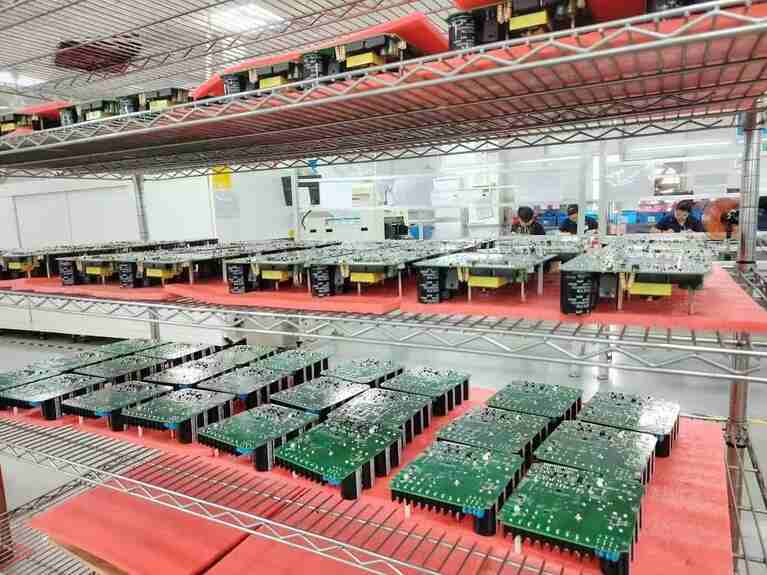
Firmware programming is a critical post-assembly step in PCB assembly service, where software (e.g., control algorithms, security keys) is loaded onto microcontrollers (MCUs) or memory chips (e.g., Flash, EEPROM) in PCBs. However, this process is prone to errors: duplicate serial numbers, incorrect firmware versions, or unauthorized code can lead to field failures, security breaches, or non-compliance with industry regulations (e.g., GDPR for device traceability, ISO 13485 for medical devices). For a PCB assembly service, designing robust error-proofing mechanisms is essential to ensure 100% Burn accuracy—especially for high-reliability applications like automotive ECUs or industrial IoT gateways.
ShwayPCB’s
specialized PCB assembly service has implemented Burn error prevention systems for 2,000+ clients, achieving zero critical errors in 10M + Burn cycles. Below, we break down the design of end-to-end Error prevention mechanism,from serial number generation to post - Burn encryption verification.
Unique serial numbers are the first line of defense against Burn errors—they enable traceability, prevent duplicates, and ensure firmware-version matching. High-Reliability PCB Assembly Service uses a standardized SN generation framework:
A robust SN (16–32 characters) includes embedded metadata to enable automated validation:
- Manufacturer Code: 2–4 alphanumeric characters (e.g., “FR4” for ShwayPCB) to identify the assembly partner.
- Product ID: 4–6 characters (e.g., “ECU001” for automotive ECUs) to link the SN to a specific PCB model.
- Batch Number: 4–8 characters (e.g., “B202508” for August 2025 batch) for batch-level traceability.
- Unique Counter: 6–12 numeric characters (e.g., “000001” to “999999”) to ensure no duplicates per product model.
Example SN: FR4-ECU001-B202508-000456 (links to ShwayPCB’s automotive ECU, Batch B202508, unique unit 456).
To avoid duplicates and ensure security:
- Centralized SN Server: Use a cloud-based server (e.g., AWS IoT Core) with a database that generates and locks SNs in real time—each SN is marked as “used” immediately after Burn,preventing reuse.
- Encryption of SN Transmissions: Send SNs to Burn stations via TLS 1.3 encryption to prevent interception or tampering (critical for sensitive applications like payment terminals).
- Offline Backup: For facilities with unstable internet, pre-generate encrypted SN batches (signed with digital certificates) that expire after 72 hours—prevents long-term storage of unused SNs.
Before initiating firmware Burn,the system validates the SN via three checks:
- Format Check: Verify SN length, character types, and metadata consistency (e.g., “ECU001” Product ID matches the PCB model).
- Duplicate Check: Query the centralized server to confirm the SN is unused.
- Signature Check: Validate the SN’s digital signature (from the server) to ensure it was not tampered with.
Impact: A client’s industrial sensor PCB had 5% duplicate SNs before implementing this system—post-implementation, duplicates dropped to 0%, meeting Traceable PCB Assembly Service requirements.
Loading the wrong firmware version (e.g., a 2023 version onto a 2025 PCB) is a top Burn error—Automotive-Grade PCB Assembly Service uses two-layer verification to prevent this:
- PCB ID Reading: Use a barcode/QR scanner to read the PCB’s Product ID (printed on the solder mask) and send it to the firmware server.
- Version Matching: The server retrieves the latest firmware version compatible with the Product ID (e.g., “FW-ECU001-V2.5” for ECU001 PCBs) and sends it to the Burn station—older versions are flagged as “incompatible.”
- Checksum Validation: The firmware file includes a SHA-256 checksum; the Burn station verifies the checksum before loading to ensure the file was not corrupted during transmission.
After Burn,the system reads the firmware version stored in the PCB’s MCU and compares it to the expected version:
- Use in-circuit debugging (ICD) tools (e.g., Texas Instruments XDS110) to access the MCU’s version register.
- If the versions mismatch (e.g., expected V2.5, read V2.4), the PCB is flagged as “failed” and sent to rework—no failed units proceed to the next assembly stage.
Case Study: A client’s EV battery management PCB (BMS) had 8% wrong firmware errors—implementing version verification cut errors to 0.3%, ensuring compliance with ISO 15118 (EV charging standards).
For secure applications (e.g., medical devices, financial terminals), Burn error prevention must include encryption checks to ensure only authorized firmware is loaded—Secure PCB Assembly Service uses these mechanisms:
- The firmware server stores firmware files encrypted with AES-256—only the burn station (equipped with a unique decryption key) can decrypt them.
- Keys are stored in hardware security modules (HSMs) (e.g., Gemalto SafeNet) to prevent unauthorized access—keys are never stored on the burn station’s local drive.
After 烧录,the system verifies that the firmware is properly encrypted in the MCU:
- Secure Boot Check: Trigger the MCU’s secure boot feature (e.g., ARM TrustZone) to confirm the firmware signature matches the manufacturer’s public key—if not, the MCU refuses to boot, and the PCB is rejected.
- Encryption Status Read: Use JTAG/SWD interfaces to read the MCU’s encryption status register (e.g., “0x01” for encrypted, “0x00” for unencrypted)—unencrypted PCBs are quarantined for rework.
- Embed a tamper-detection flag in the firmware; if the PCB is opened or the firmware is modified, the flag is set to “1,” and the MCU locks itself—preventing unauthorized code execution.
Result: ShwayPCB’s secure burn system prevented 12 attempted instances of unauthorized firmware loading for a client’s medical infusion pump PCBs, meeting FDA 21 CFR Part 11 (electronic records security).
Comprehensive traceability is critical for debugging errors and meeting regulations—PCB assembly service maintains detailed audit trails for every burn cycle:
The burn system logs 10+ data points per PCB, stored in a centralized database for 10+ years:
- SN, Product ID, firmware version, burn timestamp, and operator ID.
- Pre- and post - burn check results (e.g., “SN valid,” “version match,” “encryption verified”).
- Any errors (e.g., “checksum failed,” “version mismatch”) and their resolution (e.g., “re - burn with correct firmware”).
- Generate daily/weekly reports on burn metrics: total units, error rate, error types, and rework rate.
- For regulatory audits (e.g., AEC-Q100, ISO 13485), generate traceability reports for specific batches or SN ranges in <5 minutes.
Benefit: A client’s recall of 1k industrial PCBs (due to a firmware bug) was resolved in 48 hours—thanks to traceability data, only the affected batch (identified via SNs) was recalled, reducing costs by 90%.
Yes—ShwayPCB’s quickturn system uses pre-configured SN batches and cloud-based firmware servers to enable error-proofing in 24–48 hours:
- Pre-generated SNs for common PCB models (e.g., IoT sensors) are available on-demand.
- Firmware version matching is automated via a web portal—clients upload their firmware, and the system validates compatibility.
Failed PCBs are sent to a dedicated rework station:
- The MCU is erased via a high-voltage eraser (e.g., STMicroelectronics ST-LINK) to remove unauthorized code.
- The PCB is re - burn with the correct encrypted firmware and re-verified—success rate >95% for reworked units.
For multi-MCU PCBs (e.g., automotive ADAS with 3+ MCUs):
- Each MCU has a unique sub-SN (linked to the main PCB SN) for individual tracking.
- The system burn s and verifies each MCU sequentially—if one MCU fails, the entire PCB is held until the issue is resolved.
Yes—verification tools (scanners, ICDs) work with both SMT (e.g., QFN MCUs) and THT (e.g., DIP Flash chips) components:
- For THT components, use needle probes to access version registers if barcode scanning is not possible.
Initial setup costs (server, HSM, software) are $10k–$30k, but long-term savings are significant:
- Reduced rework (cuts labor costs by 40%).
- Fewer field failures (avoids $10k–$100k recall costs).
ROI is typically achieved within 6–12 months for high-volume projects.
Programming error-proofing mechanisms—from unique SN generation to encryption verification—are non-negotiable for PCB assembly service in high-reliability, secure applications. These systems not only prevent costly errors but also ensure compliance with regulations and build trust with clients. For manufacturers, investing in error-proofing is an investment in long-term quality and operational efficiency.
ShwayPCB’s
specialized PCB assembly service offers end-to-end Burn error prevention solutions, including
High-Reliability PCB Assembly Service,
Automotive-Grade PCB Assembly Service, and
Secure PCB Assembly Service. Our team designs custom error-proofing workflows, integrates with client firmware servers, and provides ongoing support to ensure zero critical burn errors.
To request a Burn error prevention system design for your PCB, access our SN generation template, or get a secure burn quote, contact ShwayPCB at
yuan@shwaypcb.com. For detailed case studies (automotive ECUs, medical devices), visit our
specialized assembly service page.