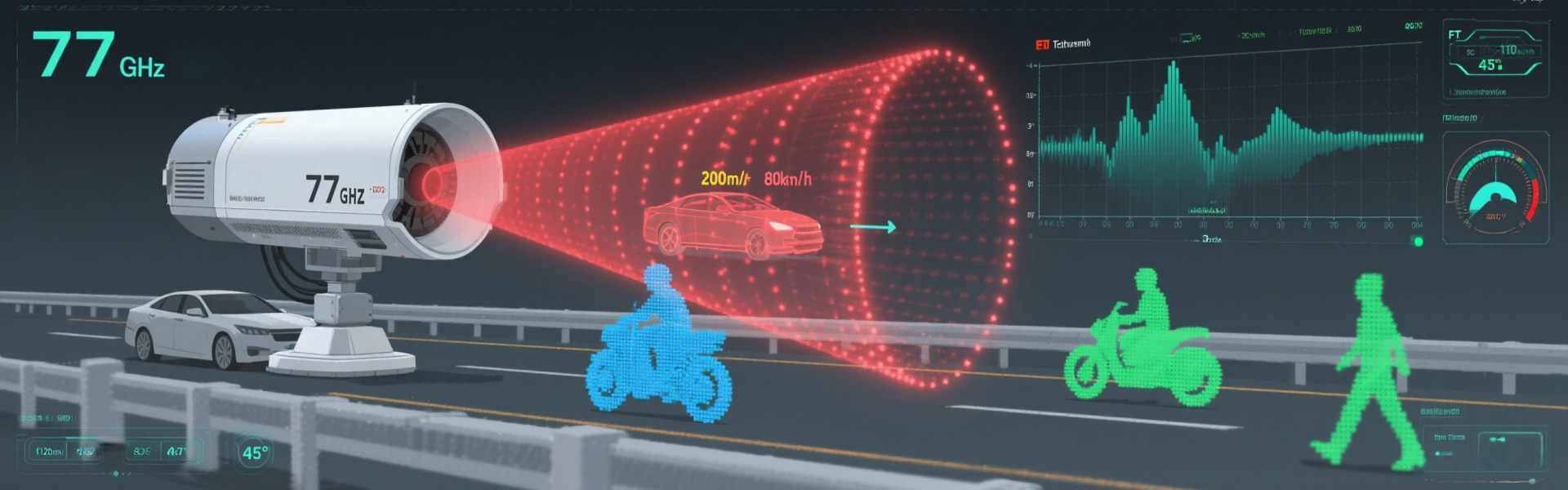
Automotive millimeter-wave radar has become the backbone of advanced driver-assistance systems (ADAS) and autonomous driving, with 24GHz and 77GHz bands dominating the market. Each frequency offers distinct trade-offs in range, resolution, cost, and application suitability, making the selection critical for vehicle safety and performance. A 2025 industry report found that 38% of automotive radar failures stem from mismatched frequency selection—using 24GHz for long-range highway scenarios or 77GHz for low-cost parking applications, for example. This guide compares 77GHz and 24GHz radar across technical, regulatory, and practical dimensions, helping engineers and manufacturers choose the optimal sensor for their use case. For deeper insights into millimeter-wave radar technology, refer to the
comprehensive analysis of millimeter-wave radar modules.
The performance gap between 77GHz and 24GHz radar stems from their fundamental frequency properties, which dictate range, resolution, and environmental resilience:
- 24GHz Radar: Operates in the 24–26GHz band, with a wavelength of ~12.5mm. Its maximum reliable detection range is 50–100m, making it suitable for short-to-mid-range applications like parking assistance and blind-spot monitoring. Beyond 100m, signal attenuation and lower transmit power (regulated to <20dBm) limit performance.
- 77GHz Radar: Uses the 76–81GHz band, with a shorter 3.8–4mm wavelength. It achieves long-range detection (150–200m) for highway scenarios, enabled by higher allowed transmit power (<33dBm) and lower atmospheric absorption at millimeter wavelengths. This range is critical for adaptive cruise control (ACC) and forward collision warning (FCW) in high-speed driving.
- Angular Resolution: Defines the ability to distinguish between closely spaced objects (e.g., a motorcycle next to a car). 77GHz radar, with its shorter wavelength, achieves angular resolution of 1–3° (with MIMO antenna arrays), vs. 3–5° for 24GHz. This makes 77GHz far better at resolving complex urban environments.
- Range Resolution: Determines precision in measuring distance to objects. 77GHz systems, using wider bandwidth (4GHz vs. 2GHz for 24GHz), achieve range resolution of <0.5m, compared to 1–2m for 24GHz. This is vital for detecting small objects like pedestrians or cyclists.
Both frequencies outperform cameras and LiDAR in adverse weather, but 77GHz has a slight edge:
- Rain/Fog Penetration: 77GHz waves (4mm) scatter less off water droplets than 24GHz waves (12.5mm), maintaining ~90% performance in heavy rain vs. 70–80% for 24GHz.
- Temperature Stability: 77GHz radar modules exhibit less frequency drift in extreme temperatures (-40°C to 85°C), critical for consistent performance in automotive environments.
- Parking Assistance: Detects obstacles within 0–5m, using 24GHz’s compact antenna size (due to longer wavelength) for easy integration into bumpers.
- Blind-Spot Monitoring (BSM): Monitors adjacent lanes up to 30m, where 24GHz’s lower cost and sufficient resolution suffice.
- Low-Speed Collision Avoidance: In urban traffic (<30km/h), 24GHz provides adequate detection of nearby vehicles and pedestrians.
- Adaptive Cruise Control (ACC): Maintains safe distances from vehicles 100–200m ahead on highways, requiring 77GHz’s range and resolution.
- Forward Collision Warning (FCW) and Automatic Emergency Braking (AEB): Detects distant obstacles (e.g., stopped cars) and initiates braking, relying on 77GHz’s precision to avoid false alarms.
- Complex Urban Sensing: Distinguishes between pedestrians, cyclists, and vehicles in crowded environments, enabled by superior angular resolution.
- 24GHz: Allocated globally but faces increasing congestion from non-automotive devices (e.g., industrial sensors), raising interference risks. Some regions (e.g., EU) plan to phase out 24GHz automotive radar by 2027 in favor of 77GHz.
- 77GHz: Reserved exclusively for automotive use worldwide, minimizing interference. This regulatory protection ensures long-term viability, a key factor for automotive OEMs planning 5–10 year product lifecycles.
- 24GHz Radar: Lower material and manufacturing costs (~30–50% cheaper than 77GHz) due to simpler RF frontends and larger wavelength (easier antenna design). Modules cost $20–$50 in volume.
- 77GHz Radar: Requires advanced semiconductors (e.g., SiGe or GaN MMICs) and precision PCB fabrication (low-loss substrates like Rogers 4350) to handle high frequencies. Modules cost $50–$150 in volume, but prices are declining with scaling.
Use this decision tree to align frequency with requirements:
-
Define Range Needs:
- <100m: 24GHz suffices (e.g., parking, BSM).
-
100m: 77GHz is mandatory (e.g., highway ACC).
-
Evaluate Resolution Requirements:
- Need to distinguish objects <1m apart: 77GHz.
- Simple environments (large, spaced objects): 24GHz.
-
Consider Cost Targets:
- Budget-constrained entry-level vehicles: 24GHz for non-critical functions.
- Premium/ADAS-focused vehicles: 77GHz for safety-critical systems.
-
Assess Regulatory Compliance:
- Long-term (post-2027) projects: Prioritize 77GHz to avoid 24GHz phase-outs.
A: Yes—its higher cost and long-range capabilities are unnecessary for <5m detection. 24GHz offers better cost-performance for parking applications.
A: Both complement cameras and LiDAR: 77GHz provides long-range, all-weather data for safety systems, while 24GHz supports short-range redundancy. Data fusion ensures robust perception.
A: Not entirely, but its use will decline. Regions like the EU are restricting 24GHz to low-power, short-range use, pushing OEMs toward 77GHz for most ADAS functions by 2030.
77GHz and 24GHz radar serve distinct roles in automotive sensing: 77GHz excels in long-range, high-resolution scenarios critical for safety, while 24GHz offers cost-effective short-range performance. As ADAS requirements evolve, 77GHz is becoming the standard for new vehicles, with 24GHz retained for niche, low-cost applications. For detailed comparisons of radar modules across frequencies, refer to the
comprehensive analysis of millimeter-wave radar modules. ShwayPCB specializes in manufacturing high-performance PCBs for both 24GHz and 77GHz radar systems, leveraging expertise in low-loss materials and precision fabrication. To discuss radar PCB solutions, contact ShwayPCB at
yuan@shwaypcb.com.