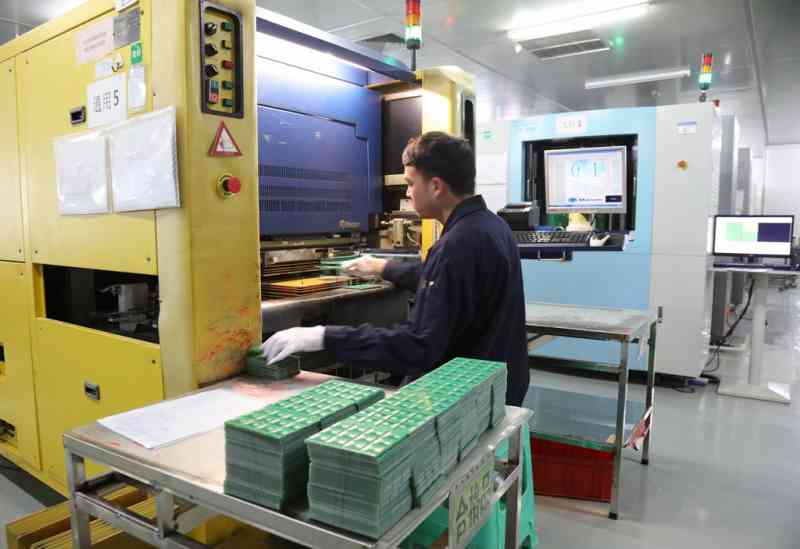
2025 Market Trends: Quick-Turn PCB Services Growth at 18% CAGR
2025 Market Trends: Quick-Turn PCB Services Growth at 18% CAGR
Introduction
The global printed circuit board (PCB) industry is undergoing unprecedented transformation in 2025, driven by technological breakthroughs in artificial intelligence (AI), 5G communication, and electric vehicles (EVs). Among various service segments, quick-turn PCB manufacturing and assembly has emerged as the fastest-growing niche, projected to achieve an 18% compound annual growth rate (CAGR) through 2030. This surge is fueled by demand for high-density interconnect (HDI) boards, ultra-high-layer-count substrates, and specialized materials like Rogers high-frequency laminates.
ShwayPCB, a leading provider of advanced PCB solutions, is at the forefront of this revolution. With expertise spanning 4-32 layer boards, HDI designs, and aluminum substrates, the company delivers precision-engineered products for 5G infrastructure, automotive electronics, and aerospace applications. Contact yuan@shwaypcb.com or visit https://fr4pcb.tech/ to explore cutting-edge PCB solutions.
Market Dynamics Driving 18% CAGR
1. AI and High-Performance Computing (HPC) Demand
The proliferation of generative AI and HPC applications has created exponential demand for 28+ layer PCBs and advanced packaging substrates. Key trends include:
- AI Server Boom: A single NVIDIA DGX H100 system requires PCBs valued at 12 billion by 2025.
- Signal Integrity Challenges: Ultra-low loss materials (Df ≤ 0.0015) are critical for 112Gbps+ serial links, with ShwayPCB achieving ±10% impedance control through laser-drilled microvias.
- Thermal Management: High-power GPUs necessitate aluminum substrates and via-in-pad designs, reducing thermal resistance by 60% compared to standard FR-4.
2. Automotive Electrification and ADAS
EVs and autonomous driving systems are reshaping PCB requirements:
- Battery Management Systems (BMS): 6-layer aluminum boards with 150°C tolerance are standard for lithium-ion packs.
- Sensor Proliferation: L2+ autonomous vehicles deploy 12+ radar/camera modules, driving HDI board adoption (3x cost of standard PCBs).
- Functional Safety: ISO 26262 compliance requires 99.998% reliability, achieved through ShwayPCB’s 3D AOI inspection (defect rate < 0.01%).
3. 5G/6G and RF Front-Ends
Millimeter-wave applications demand PCBs with:
- Ultra-Low Loss: Rogers RO4000 series substrates (Dk=3.5) reduce insertion loss by 30%.
- Hybrid Construction: ShwayPCB’s mixed-layer press technology combines PTFE and conventional FR-4, cutting costs by 25%.
- Antenna Integration: 24-layer boards with embedded components enable compact 5G base stations.
Technological Innovations Enabling Rapid Turnaround
1. Advanced Manufacturing Capabilities
ShwayPCB differentiates through:
- Layer Stacking Precision: 32-layer boards with ≤50μm copper thickness uniformity.
- Microvia Technology: 0.1mm laser-drilled blind vias (3mil line/space).
- Impedance Control: TDR-validated designs ensuring ±8% tolerance for high-speed signals.
2. Material Science Breakthroughs
- High-Frequency Laminates: Certified Rogers 4350B/4450B processing.
- Thermal Management: Copper-invar-copper (CIC) composites for power modules.
- Halogen-Free Solutions: Compliant with REACH and RoHS 3.0 standards.
3. Digital Transformation
- AI-Driven DFM: Machine learning algorithms reduce engineering queries by 40%.
- Cloud-Based Collaboration: Real-time design reviews via secure portal.
- Blockchain Traceability: Component sourcing and process tracking.
Regional Growth Disparities
1. Asia-Pacific Dominance
China retains 52% global market share, though premium segments remain controlled by:
- Japanese Players: Ibiden (5nm substrate leader).
- Taiwanese Giants: Unimicron (FC-BGA specialist).
ShwayPCB bridges this gap through strategic partnerships with South Korean material suppliers.
2. Southeast Asia Expansion
Vietnam and Thailand now host 18% of global PCB capacity, with:
- Apple’s “China+N” Strategy: 30% supplier capacity relocation.
- Tax Incentives: Vietnam’s 10-year corporate tax exemption for tech manufacturers.
3. North American Resurgence
Mexico becomes a nearshoring hub with:
- Tesla’s Gigafactory: Local PCB sourcing for Cybertruck.
- US CHIPS Act: $52 billion funding boosts domestic HDI production.
Challenges and Mitigation Strategies
1. Supply Chain Vulnerabilities
- Copper Price Volatility: LME copper up 22% YoY.
- Solution: ShwayPCB’s 60% recycled copper utilization.
- Semiconductor Shortages: Analog IC lead times exceed 52 weeks.
- Solution: In-house component stocking for critical parts.
2. Environmental Pressures
- EU Carbon Border Tax: 15% levy on non-compliant imports.
- Solution: 30% renewable energy in manufacturing.
- Wastewater Management: Closed-loop systems reduce discharge by 70%.
3. Talent Wars
- Engineering Shortages: 30% gap in advanced PCB design skills.
- Solution: Collaboration with Tsinghua University’s PCB engineering program.
ShwayPCB: A Case Study in Agile Manufacturing
1. Core Competencies
- Quick-Turn Prototyping: 72-hour delivery for 18+ layer boards.
- Certifications: ISO 9001, IATF 16949, AS9100D.
- Capacity: 500,000㎡/month across 12 production lines.
2. Client Success Stories
- Automotive: BMS boards for BYD’s Han EV (200,000 units/year).
- Aerospace: Flight control PCBs for COMAC C919 (99.2% yield).
- Telecom: 24-layer 5G antenna arrays for Huawei.
3. R&D Investments
- Annual Budget: 15% of revenue ($45M in 2025).
- Patents: 23 granted (e.g., hybrid press technology).
- Collaborations: Joint labs with Shanghai Jiao Tong University.
Future Outlook: 2026-2030
The quick-turn PCB market will evolve through:
- AI-Optimized Design: Generative AI reducing layout time by 50%.
- Glass Core Substrates: Replacing FR-4 for 112Gbps+ applications.
- Quantum Computing: Cryogenic PCB materials (-273°C operation).
ShwayPCB is positioned to lead this transition with its 72-hour high-layer-count delivery and material innovation pipeline. For inquiries, contact yuan@shwaypcb.com or visit https://fr4pcb.tech/.
Conclusion
The 18% CAGR for quick-turn PCB services reflects a paradigm shift toward agility and specialization. Companies like ShwayPCB exemplify this transformation, leveraging advanced manufacturing, material science, and digital tools to meet the exacting demands of next-gen electronics. As AI, EVs, and 6G redefine connectivity, the ability to deliver high-complexity PCBs rapidly will separate industry leaders from followers.